Best DeepL Alternatives in 2026: Top 7 Translation Tools Compared
Choosing the right translation tool in 2026 means weighing trade-offs that didn't exist a few years ago: multi-model AI comparison, tone control, and support for less common languages. DeepL remains a powerhouse for European languages, but its narrower language coverage, limited file formats, and data residency questions push many users toward alternatives. This guide compares seven leading options head-to-head so you can pick the best DeepL alternative for your specific workflow.

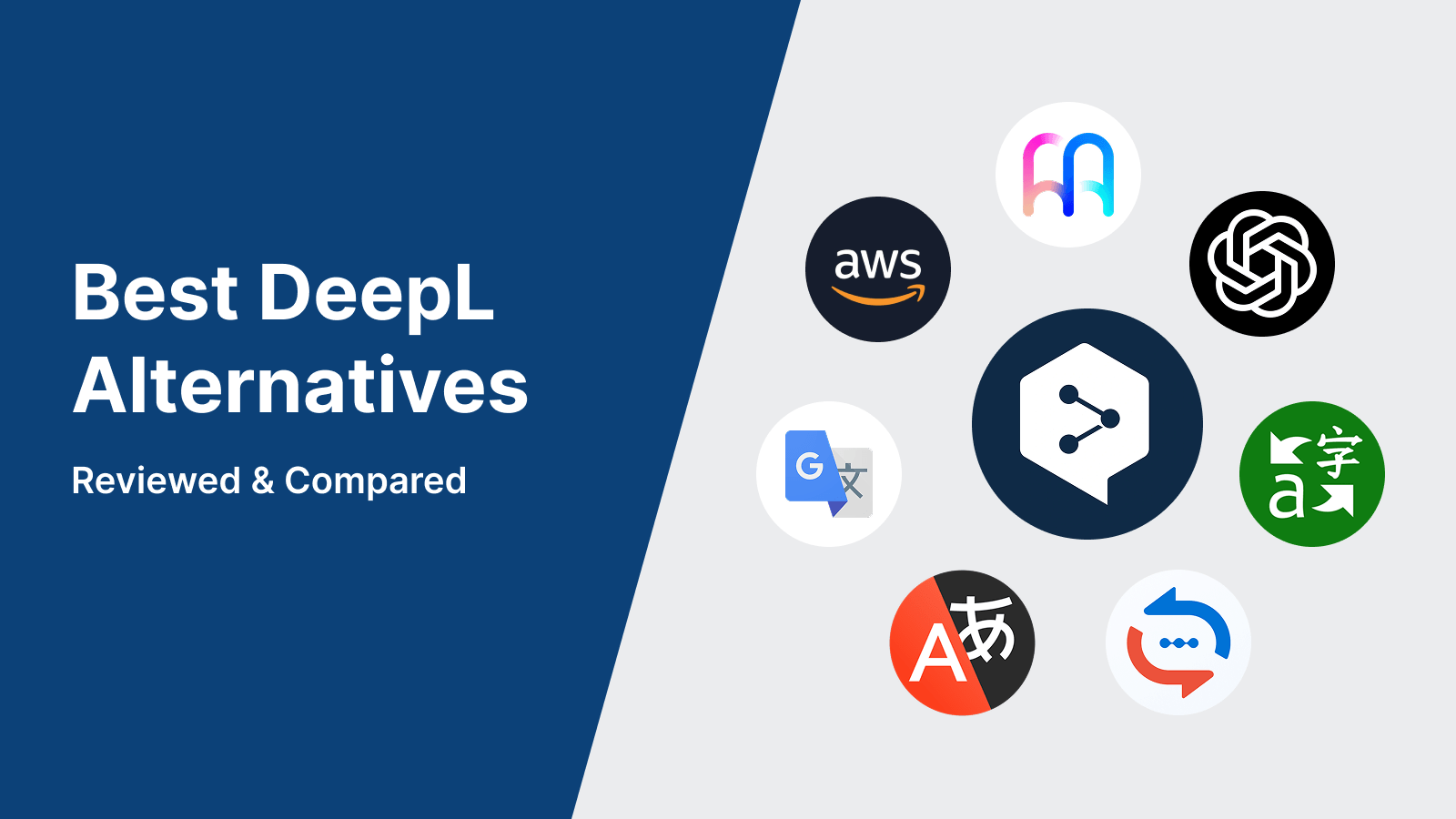
The short answer: MixTranslate is the strongest all-around alternative for most users - it lets you compare outputs from 20+ AI models side by side, offers generous free credits, covers 150+ languages, and guarantees your data is never stored or used for training. Choose Google Translate when you need maximum language coverage (249+ languages), Microsoft Translator for enterprise integration, and ChatGPT for nuanced, idiomatic translations that need human-level context.
What Is DeepL?
DeepL is a premium neural machine translation service launched in 2017 by a German tech company. It's widely regarded as the gold standard for accurate translations in European languages - in a March 2026 blind test, DeepL won 94% of matchups across 16 language pairs versus GPT-5.2, Gemini 3.1 Pro, Claude Opus 4.6, Google Translate, and Microsoft Translator.
Core strengths include natural-sounding translated text with strong formal/informal distinction, document translation with layout preservation, and enterprise features like DeepL Write for style refinement, custom glossaries, and translation memory via its Customization Hub. DeepL maintains ISO 27001 and SOC 2 Type 2 certifications, and DeepL Pro plans ensure customer data isn't used for model training.
However, several limitations drive users to seek alternatives. DeepL supports only 100+ languages after recent expansions - far fewer than competitors for text and voice. DeepL supports only 3 file formats for document translation: DOCX, PDF, PPTX. DeepL lacks built-in translation memory for consistency across projects, and DeepL Pro plans limit monthly document translations per user. DeepL allows file uploads up to 30MB in size, which can be restrictive for large business documents. The free version stores translations temporarily for model improvement, and DeepL's expanding infrastructure now includes AWS as a sub-processor, raising questions about regional data residency.
Top DeepL Alternatives: How They Compare at a Glance
| Alternative | Best For | Languages Supported | Free Tier | Key Differentiator |
|---|---|---|---|---|
| MixTranslate | Multi-model comparison, privacy, tone control | 150+ languages | 10000 welcome credits + 100000 free credits/month | Side-by-side outputs from 20+ AI models with quality metrics |
| Google Translate | Maximum language breadth, casual use | 249+ languages and dialects | Free web/app; paid API | Widest language coverage; live headphone translation |
| Microsoft Translator | Enterprise workflows, Microsoft ecosystem | 179 languages/varieties | 2M characters/month free API | Deep Office 365/Teams/Azure integration; Document Translation API |
| ChatGPT Translate | Idiomatic, creative, context-heavy text | 40+ languages | Limited free tier | Explains translation choices; handles nuance and implied meaning |
| Reverso | Document layout, language learning | 29 languages (documents) | ~2,500 words free | Translation memory, inline review editor, contextual examples |
| Amazon Translate | AWS pipelines, developer integration | 75+ languages | 2M characters/month for 12 months | Custom terminology, parallel data, batch translation via S3 |
| Yandex Translate | Quick translations, regional use | Considerable breadth | Mostly free | Web page and image translation; low cost |
No single translation tool wins on every criterion. MixTranslate is carving out a strong niche for privacy-conscious users who want model comparison and tone control; Google and Microsoft dominate on scale and ecosystem; Reverso shines for professional translation workflows with layout preservation.
Multi-Model AI Comparison and Quality
Single-engine translation software - whether DeepL, Google Translate, or any standalone NMT system - carries fixed biases: preferred phrasings, strengths in certain language pairs, and blind spots for idioms or discontinuous multi-word expressions. A 2026 study published in MonTi found GPT-4o statistically significantly outperformed both DeepL and Google Translate for multi-word expressions, especially discontinuous ones. Meanwhile, a Frontiers in AI study showed ChatGPT outperformed DeepL and Google Translate in fidelity, fluency, cultural sensitivity, and persuasiveness for Chinese-to-English tourism texts when prompts were crafted appropriately.
This is exactly why comparing multiple AI models matters. Different translation engines excel in different domains - legal documents might favor one model, while marketing copy might favor another.
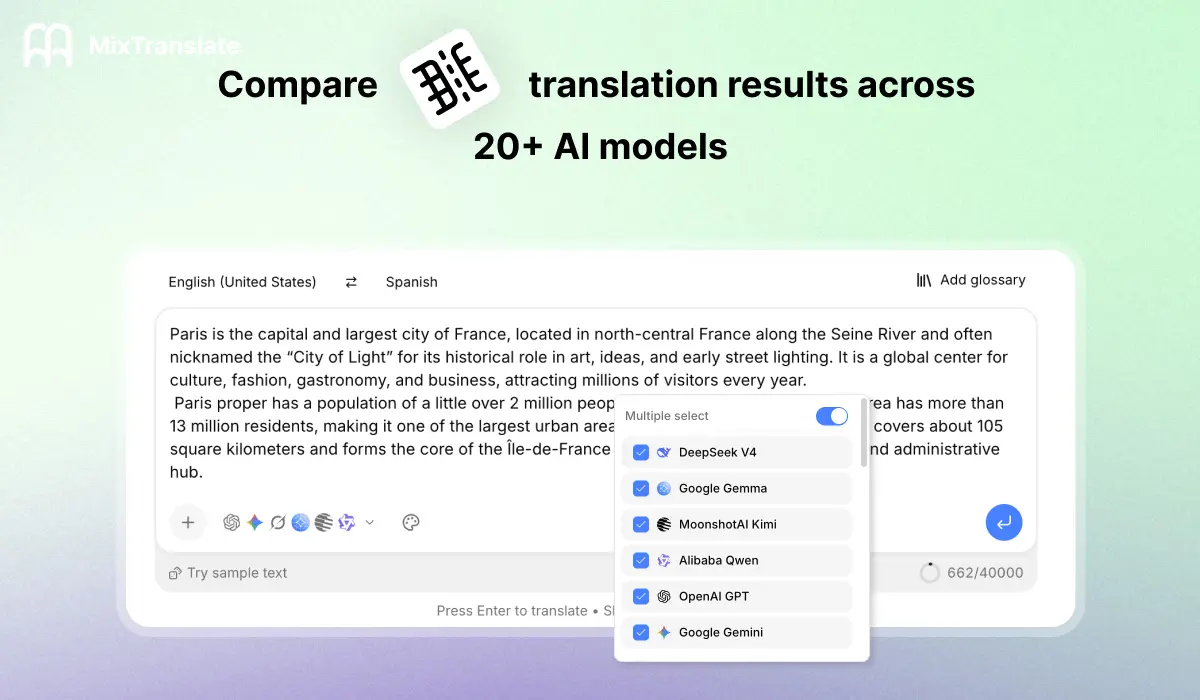
MixTranslate offers a free tool for comparing outputs from over 20 AI models - including OpenAI/GPT, Claude, Gemini, and DeepSeek - displayed side by side with quality metrics for accuracy, fluency, and context. Users can adjust tone and style, apply glossaries for consistent terminology, and extract text from images, all while knowing their data is never stored. MixTranslate allows tone and style control in translations, making it possible to fine-tune outputs for formal business use or casual communication without switching between a separate tool for each task.
For technical terminology, a comparison study on English-to-Indonesian computer terms found ChatGPT and Gemini produced 18/21 accurate translations versus DeepL's 15/21 and Google's 16/21. These gaps widen with less common languages and specialized domains - precisely where multi-model comparison delivers the most value.
Winner: MixTranslate - it's the only translation platform that lets you run one input through 20+ models and pick the best result with transparent quality scores. The trade-off: more manual effort than a single-engine tool like DeepL, and potentially slower for very large batch translation jobs. DeepL remains the best tool for users who want top-tier European language quality without selection overhead.
Language Coverage and Support
Language coverage is often the deciding factor when evaluating a better alternative to DeepL. Google Translate covers over 249 languages and dialects - including many low-resource and minority languages that no other consumer translation tool matches. Google Translate also covers over 133 languages and handles low-resource languages better than most competitors.
MixTranslate supports translation into over 150 languages, offering multilingual support that significantly exceeds DeepL's approximately 100+ supported languages. Microsoft Translator covers 179 languages and varieties for text, with text-to-speech in roughly 76 languages. Taia supports 204 languages and 65+ file formats, making it another strong contender for broad coverage. Amazon Translate supports over 75 languages for standard translation, and Reverso is limited to 29 languages for document translation.
Quality varies dramatically by language pair, though. For major European languages like French, German, and Spanish, translation quality is high across most tools. For less common languages - Swiss German dialects, certain Southeast Asian languages, or low-resource African languages - accuracy and fluency drop across every platform. Translation quality varies by language pair in Lingvanex and similar tools, and this inconsistency is common industry-wide. The key question is whether you need broad coverage for more languages or deep quality for select languages.
Winner: Google Translate - no competitor matches its 249+ languages. But if you need quality over sheer breadth, MixTranslate's 150+ languages combined with multi-model comparison lets you find the most accurate output for any given language pair, including minor languages where single-engine tools often falter. Human review remains essential for business-critical content in any less common language.
Pricing and Value
Free tier generosity varies enormously across DeepL alternatives:
- MixTranslate: Free signup gives 10,000 welcome credits plus up to 100,000 free credits per month. Free features include multi-model comparison, image text extraction, quality scores, and tone/style control - more value than most paid tiers elsewhere.
- Google Translate: Fully free for web and app users. Google Translate operates on a pay-as-you-go pricing model for API access. Google Translate is often the best free option for quick translations.
- Microsoft Translator: Free API tier up to 2 million characters per month - generous for developers and small teams.
- Amazon Translate: Free tier of 2 million characters per month for the first 12 months; $15 per million characters after that for standard text; $60/million for active custom translation.
- Reverso: Free plan limited to approximately 2,500 words; paid plans or credit packs unlock OCR for scanned PDFs and larger file sizes.
- DeepL: Free version has word limits and stores data for training. DeepL Pro plans start at subscription pricing and limit monthly document translations per user.
Google's free tools are less secure than paid options - an important consideration for business use. The paid version of most tools unlocks enterprise security, larger word limits, and priority support.
Several AI-driven translation tools rival DeepL in 2026, and the credits-based model that MixTranslate uses provides more value for individual users and small teams who want premium AI translation without monthly subscriptions.
Winner: MixTranslate for free usage - 100,000 monthly credits with full feature access is unmatched. For high-volume enterprise or API-heavy workflows, Microsoft Translator and Amazon Translate offer the best scale pricing. DeepL's pro plan delivers premium European-language quality but at a higher cost with format limitations.
Privacy and Data Security
Translation tools should not use data for model training - a principle that's becoming the baseline expectation in 2026 as GDPR, the EU AI Act, and evolving U.S. privacy laws tighten requirements.
MixTranslate provides strong data privacy by not storing translations for training purposes. Translations are processed and returned without being retained on servers - a clear advantage for users handling sensitive legal documents, financial reports, or confidential marketing copy.
DeepL and Taia ensure GDPR-compliant data processing. DeepL maintains ISO 27001 and SOC 2 Type 2 certifications, and DeepL Pro ensures customer data isn't used for training. However, DeepL's free version does temporarily store and use submissions for model improvement, and its expanding infrastructure now includes AWS as a sub-processor, raising data residency questions. Taia offers ISO 17100 certification for data security, adding another layer of assurance for professional teams.
Microsoft Translator benefits from Azure's enterprise security framework, including regional data residency controls, compliance certifications, and configurable data protection policies - strong for enterprise security requirements. Reverso offers GDPR compliance, encrypted uploads, and European infrastructure with sovereign hosting options for enterprise accounts.
Amazon Translate inherits AWS compliance certifications and gives customers control over data retention, but transparency around whether standard translations feed model improvement requires careful review of AWS documentation. Pairaphrase is highly regarded for high-security translation needs, making it worth evaluating for regulated industries.
Yandex Translate claims encryption and SOC 2 compliance, but jurisdictional concerns - particularly regarding potential legal obligations to disclose data - make it a weaker choice for privacy-sensitive workflows.
Winner: MixTranslate - its no-storage, no-training policy is the simplest and strongest privacy guarantee available. DeepL Pro is a close second with its certifications and GDPR compliance, though the expanding sub-processor network adds complexity. For enterprise-scale data protection with full compliance frameworks, Microsoft Translator on Azure is the strongest.
Integration and Workflow Features
How a translation platform fits into your existing workflow often matters as much as translation quality itself. A good translation tool should integrate with existing software - and the options diverge significantly here.
API access and developer tools: Amazon Translate provides strong API integration for developers, with batch document jobs via S3, custom terminology, and parallel data for style mimicking. DeepL supports API integration for custom systems and offers plugins for Microsoft Office and browser extensions. Microsoft Translator's Document Translation API - which reached GA in March 2026 - supports preserving structure, images, and OCR across Word, PowerPoint, and image file types. MixTranslate connects to 20+ AI models and supports image text extraction; its API access details are expanding. Taia can set up custom connections for workflows like Jira.
Browser extensions and mobile apps: DeepL offers plugins for Microsoft Office and browser extensions for Chrome. Reverso provides browser extensions for Chrome, Edge, and Firefox. Google Translate is deeply embedded in Android, Chrome, and Google Docs, with live translation expanding to headphones in 70+ languages across Android, iOS, and more countries in 2026. Microsoft Translator is excellent for enterprise integration and used in Microsoft 365 environments, including Teams and Microsoft Office.
File formats and document translation: This is where differences are stark. DeepL supports document translation for only 3 file formats: DOCX, PDF, PPTX - and allows file uploads up to 30MB. Taia supports 65+ file formats for seamless document translation and can convert PDFs into fully editable Word documents. Lara Translate supports 70+ file formats for document translation. Pairaphrase supports 30+ file types. Reverso handles technical formats including XML, XLIFF, PO, and RESX. When layout matters, Reverso's inline review editor and Microsoft's Document Translation API lead the field.
Terminology and consistency: Terminology management ensures consistent terminology across projects. Glossaries help lock in product names and technical vocabulary, and effective terminology management can speed up global rollout. DeepL lacks built-in translation memory for consistency, relying instead on glossaries and style rules. Taia offers translation memory to reduce costs on recurring content. ModernMT learns from previous translations and preserves terminology for professional translators. Translation memory reduces costs for recurring content - a critical feature for business document translation at scale.
Winner: Microsoft Translator for enterprise workflows - its deep integration with Microsoft Office, Teams, Azure, and its Document Translation API make it unbeatable for organizations in the Microsoft ecosystem. MixTranslate wins for individual users and small teams who need multi-model comparison, image extraction, and tone control without complex enterprise setup. Reverso is the best choice when document layout matters for professional documents like contracts and financial reports.
Which DeepL Alternative Should You Choose?
- Choose MixTranslate if you want to compare multiple AI models side by side, need privacy guarantees (no storage, no training), value tone and style control, translate from images or scanned content, or want the most generous free tier available. It's the best deepl alternative for content creators, documentation teams, and anyone who wants AI translation with transparency.
- Choose Google Translate if you need maximum language coverage across 249+ languages and dialects, want free translations for casual or everyday use, or need features like live headphone translation and deep integration across Android, Chrome, and Google Docs.
- Choose Microsoft Translator if you work in the Microsoft ecosystem, need enterprise security and compliance, handle business documents requiring layout preservation, or need batch translation through Azure APIs across multiple languages.
- Choose ChatGPT if you need context-aware translations with explanation capabilities. ChatGPT excels in nuanced, idiomatic, or creative translation through context and prompt-driven adjustments - ideal for literary text, marketing copy, or content where implied meaning matters more than literal accuracy.
- Choose Reverso if your focus is document translation with layout preservation, inline review, and translation memory - especially for legal documents, financial reports, or academic papers. Reverso Context is particularly useful for language learners because it shows real-world usage examples.
- Choose Amazon Translate if you're building translation into AWS-hosted applications, need custom terminology with parallel data, or require scalable pay-as-you-go batch translation inside your cloud infrastructure.
For the strongest all-around pick, MixTranslate delivers the most value to the widest range of users: multi-model comparison ensures higher translation quality, 150+ supported languages provide broad coverage, the free credit system is genuinely generous, and the no-storage privacy policy removes a major concern. It won't replace Microsoft Translator for enterprise-scale deployments or Google Translate for sheer language breadth - but for anyone actively comparing DeepL alternatives, it's the best place to start.
Frequently Asked Questions
Is MixTranslate really free to use?
Yes. Upon signing up, you receive 10,000 welcome credits, then earn up to 100,000 free credits per month for continued use. These credits cover core features: multi-model comparison, image text extraction, tone/style control, quality metrics, and glossary-based terminology management.
Which alternative is most accurate for business documents?
For European markets and European languages, DeepL remains the accuracy leader - its March 2026 blind tests confirm dominance across major language pairs. For business documents that require consistent terminology, layout preservation, and format support beyond DOCX/PDF/PPTX, Microsoft Translator and Taia are stronger choices. Taia is tailored for professional teams needing context retention and document translation across 65+ file formats. MixTranslate lets business users compare outputs from multiple translation engines to select the most appropriate phrasing for formal content, which is especially useful when accuracy matters across less common language pairs.
Can I use these alternatives offline?
Google Translate and Microsoft Translator both offer offline translation packs on mobile - download language packs for use without connectivity. DeepL's desktop apps support limited offline functionality depending on your plan. MixTranslate, Reverso, Amazon Translate, and ChatGPT currently require an internet connection, as their AI models and OCR features rely on cloud processing. Offline mode in any tool typically loses access to the latest model updates, tone/style control, and image translation capabilities.
How do these alternatives handle specialized terminology?
Terminology management is crucial for maintaining brand voice across translations. Glossaries help lock in product names and technical vocabulary so key terms stay consistent. DeepL offers glossaries and style rules but lacks built-in translation memory for consistency. Microsoft Translator supports custom terminology via Translator Hub and Custom Translator, letting you train on domain-specific parallel data. Amazon Translate offers custom terminology and parallel data features. MixTranslate applies glossary terms across all 20+ model outputs simultaneously. Taia offers translation memory to reduce costs on recurring content. For specialized fields like legal, medical, or technical translation, human review remains important regardless of which tool you choose.
Which tool is best for translating from images?
MixTranslate supports text extraction from images - upload screenshots, scans, or photos to extract and translate text across 150+ languages. Microsoft's 2026 Document Translation API handles image translation within Office documents and supports .jpeg/.png formats. Reverso's premium tiers include OCR for scanned or image-based PDFs. Google Translate offers camera-based image translation on mobile with real-time overlay. DeepL's image and scanned document support is more limited and may degrade formatting. Amazon Translate does not natively process image extraction without integrating a separate tool for OCR. For the broadest image translation support with multi-model quality comparison, MixTranslate is the strongest option.