Common Types of Translation (Categorized by Approach, Method, Domain, and Format)
In this guide, we break down the most common types of translation within each category, with clear definitions and examples — so whether you're hiring a translator, planning a localization project, or studying the field, you'll know exactly which type fits your needs.

Translation sits at the heart of every cross-border interaction, from billion-dollar mergers to bedtime stories read in a foreign language. Yet not all translations are created equal, and choosing the wrong approach can cost you far more than a few awkward sentences. This guide breaks down the different types of translation by approach, method, domain, and format so you can match every project to the right strategy.
What Is Translation? (Quick Definition + Why It Matters)
At its core, translation is converting written text from one language - the source language - into a target language while preserving the intended meaning, tone, and intent of the original. The main types of translation are usually grouped by approach (human, machine, or hybrid), method (literal, free, or creative), domain (legal, financial, medical, technical, literary, and more), and format (such as audiovisual translation, subtitling, or software localization). That variety exists for good reason: a French medical report destined for a London hospital demands clinical precision, an ecommerce site localized for Brazil needs idiomatic Portuguese and localized payment details, and a Korean drama subtitled for US audiences must preserve meaning within the right cultural context while capturing cultural subtext within strict reading-speed limits.
For individuals, content creators, marketing teams, documentation writers, and support teams working across languages, choosing the wrong translation type can create expensive problems fast. Mistranslated financial documents have triggered regulatory investigations. Medical errors born from ambiguous labels have put patients at risk. And infamous product-slogan blunders have inverted a brand's message overnight, costing millions in damage control. Understanding the different types of translation is what helps you match the job to the risk, the audience, and the medium.
The sections that follow organize translation into four practical lenses: who does the work (approach), how closely the translated text follows the source (method), what industry it serves (domain), and what medium it lives in (format). You will also see how to choose the right type for different projects and where AI-powered tools such as MixTranslate fit into modern workflows when speed, consistency, and multilingual quality all matter.
Types of Translation by Approach: Human, Machine, and Hybrid
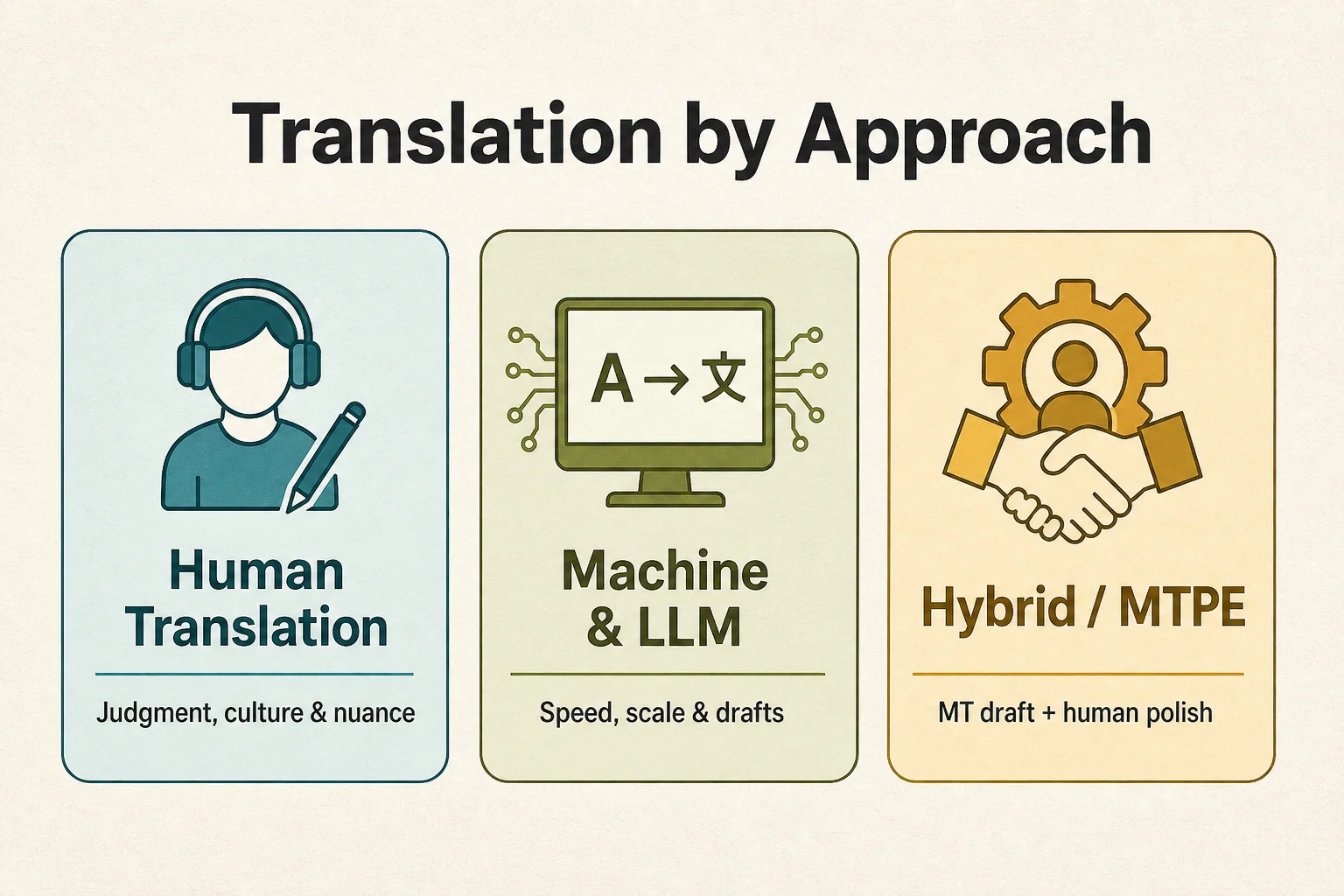
The first way to categorize translation is by who or what does the work - a human professional, translation software, or a combination of both. Since around 2017, neural machine translation and large language models have steadily shifted the boundary between these approaches, and most business workflows in 2024–2026 blend them in some form.
Human Translation
Human translation is work performed by professional translators or bilingual experts whose decisions are driven by human judgment. They may use computer assisted translation tools for memory and glossaries, but the creative and analytical choices remain theirs. Human translation typically offers the highest accuracy and nuances, which is why most publishers, courts, and regulatory bodies still require human or human-verified translations in 2026.
The strengths are clear: human translators excel at handling idiomatic expressions, irony, brand voice, and cultural references - areas where machines still stumble. Translation requires subject-matter expertise beyond just language skills, so human translators typically specialize. Legal translators focus on contracts and patents. Medical translators navigate clinical trials and regulatory norms. Literary translators bring literary skills and interpretive depth. Marketing translators adapt brand messaging for a target audience.
The limitations are equally real. Cost per word is higher, turnaround is slower for large volumes, and finding the right specialist matters - translating a 2023 oncology trial demands different subject matter expertise than a high-school textbook. Professional translators combine methods based on context and audience needs, making each project a bespoke effort.
Some scenarios remain non-negotiable for human work: court filings, clinical trial dossiers, IPO prospectuses, and high-visibility creative campaigns. In these cases, accuracy, cultural appropriateness, and legal correctness are too important to leave to algorithms alone.
Machine Translation
Machine translation is software-based translation that may lack high accuracy in nuanced contexts but excels at speed and scale. Machine translation uses algorithms to translate text automatically, and it is commonly used for large volumes of text - internal documents, user-generated content, chat support, and quick "gisting" of a foreign language article.
The evolution has been dramatic. Early rule-based systems gave way to statistical models in the 1990s, and neural machine translation transformed the field from around 2015. Today, engines like Google Translate and Microsoft Translator can process millions of words instantly at minimal cost. Yet machine translation can struggle with cultural nuances and idioms. Sarcasm, paragraph-spanning context, rare target languages, and specialized terminology still trip up even the best engines. Quality of machine translation varies by language pair complexity - a German-to-English translation will generally outperform a Swahili-to-Korean one simply because training data differs.
Machine generated translation also carries a hallucination risk: general LLMs sometimes invent content or misrepresent register. For this reason, raw MT output works best for low-risk, high-volume tasks where the goal is comprehension rather than publication-ready polish.
LLM-Powered Translation
Large language models (LLMs) such as GPT-4, Claude, Gemini, and DeepSeek have revolutionized translation since around 2023 by offering more fluid, context-aware, and adaptable translations compared to traditional machine translation engines. LLMs excel at handling longer context windows, adjusting tone and formality through prompts, and paraphrasing for improved readability. This makes LLM-powered translation highly dynamic, capable of tailoring translations to specific needs such as marketing, technical documentation, or casual conversation.
MixTranslate is a leading platform in this space, providing free access to translations in over 150 languages using outputs from more than 20 different LLMs. It allows users to compare translations side-by-side, autosuggests the best options based on tone and context, and supports style control and terminology consistency. MixTranslate also offers features like text extraction from images and ensures strong data privacy by not storing or using user content for model training.
LLM-powered translation is transforming workflows by enabling content teams to quickly generate multiple translation variants, select the most suitable one, and maintain brand voice and accuracy across languages with ease. This technology is especially valuable for fast-paced environments like ecommerce, social media, and global marketing campaigns where tone, style, and cultural nuance are critical.
Machine Translation Post-Editing (Hybrid Translation)
Hybrid translation combines machine translation with human editing to balance speed, cost, and quality. In a typical machine translation plus human editing (PEMT) workflow, MT or an LLM produces a first-draft output, and then a human editor refines it. Quality tiers range from "good enough" (light post-editing for internal use) to "professional" (thorough, polished) to "publication-ready" (highest standard).
Speed: MT generates the initial draft in seconds, even for hundreds of pages. A 2025 study in Frontiers in AI found that LLM-augmented post-editing significantly improved fluency, coherence, and style consistency across legal, medical, and public-information domains.
Cost: Machine translation post editing reduces the total hours a translator spends on a project, sometimes by 40–60 percent compared to translating from scratch.
Risk: Pure MT is risky for high-stakes translated content. Pure human work is slower and costlier. Hybrid offers the middle path - acceptable speed, reduced cost, and higher reliability.
A concrete scenario: a startup needs to translate 200 product pages into German. MT handles the bulk output overnight. Then a German-speaking marketer refines key landing pages, fixing tone, adjusting cultural references, and validating specialized terminology. The result is fast, affordable, and quality-controlled where it matters most.
Types of Translation by Method: Literal, Free, and Creative
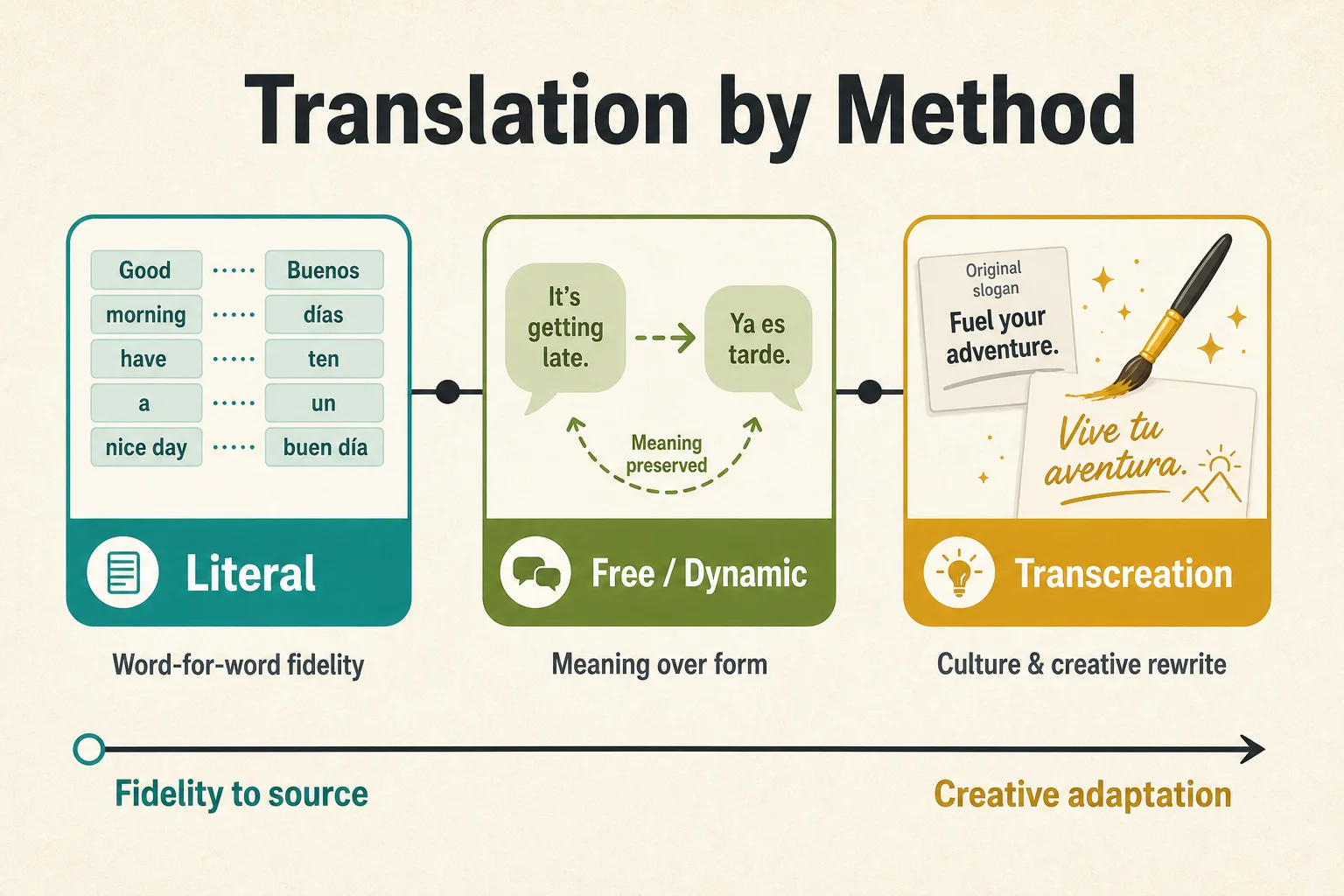
Beyond who translates, types also differ by how closely they follow the source text - from word for word fidelity to complete creative rewrites. Translation methods can include literal, free, faithful, semantic, and communicative approaches, and the choice of translation method depends on purpose, audience, and type of text.
Literal Translation (Word-for-Word)
Literal translation - sometimes called formal equivalence - preserves original structure and word order with minimal adaptation. Literal translation focuses on word-for-word accuracy, and it can work well for technical documentation, simple instructions, and short legal clauses where each term carries a strict, defined meaning.
But this approach has hard limits. Consider translating word for word the English idiom "it's raining cats and dogs" into Spanish. The result - "está lloviendo gatos y perros" - sounds absurd to any native speaker. The accurate translation would be "está lloviendo a cántaros," which captures the exact meaning without preserving word order.
Historically, literal translation has been valued in Bible translation and academic texts where formal equivalence matters for theological or scholarly debate. Some legal documents also favor it because the original wording may carry binding interpretive weight. But in most modern contexts - marketing materials, consumer-facing content, educational resources - translating word by word sacrifices naturalness and readability. The trade-off is clear: high fidelity to structure often harms transparency in the target language. That is why modern translation techniques increasingly lean toward dynamic strategies that preserve meaning over form.
Free Translation and Dynamic Equivalence
Free translation prioritizes conveying the meaning over exact wording. Rather than mirroring grammar and syntax, the translator rephrases, condenses, or expands the text to match how a native speaker would naturally express the idea. This is sometimes called dynamic equivalence, and it sits at the opposite end of the spectrum from word for word translation.
In practice, free translation is the backbone of communicative translation, which ensures the message is understood naturally by the audience. A US marketing slogan like "Reach for the Stars" might become "você pode ir além" ("you can go beyond") in Brazilian Portuguese - different words, same aspirational punch. A French comedy script might swap a culture-specific joke about French politics for a locally resonant reference, so the humor lands instead of falling flat. Idiomatic translation reproduces the message using natural expressions in the target language, which is why it is favored for consumer, educational, and public-information content.
Semantic translation considers aesthetic value and nuances of the source text, making it useful for literary or philosophical work where beauty of expression matters alongside meaning.
The risk with free translation is drift. Stray too far from the source and you may misrepresent legal or technical meaning, or introduce an interpretation the original author never intended. For this reason, high-stakes content (contracts, clinical protocols) generally avoids heavy free-translation approaches. But for marketing, education, and entertainment, it produces clearer, more engaging results.
Cultural Translation and Transcreation
Cultural translation goes further than free translation by adapting content to the target culture's norms, expectations, and sensibilities. This means adjusting date formats, measurement units, imagery, humor, and even taboos so the translated content feels native rather than imported. Adaptation allows rewriting of text to better suit the target culture, which is essential when localization process goals go beyond language into brand experience.
Transcreation adapts content creatively for specific target audiences and is commonly used in marketing and advertising. Unlike standard translation, transcreation modifies slogans and taglines for target audiences while retaining the original message's intent, tone, and style. Transcreation adapts content for specific cultural contexts - a necessity when emotional resonance matters as much as meaning.
Real-world examples illustrate the difference: McDonald's "I'm Lovin' It" became "Me encanta" in Spain - preserving rhythm and emotional energy through a localized jingle rather than a direct translation. The Dove "Real Beauty" campaign adapted its imagery and messaging to align with regional ideals of beauty, adjusting cultural norms and visual references for each market.
Successful transcreation requires understanding the target audience deeply. The workflow typically involves translator-copywriter hybrids working alongside brand guidelines and tone-of-voice documents, sometimes A/B testing local taglines before launch. LLM tools like MixTranslate can generate multiple creative variants for slogans or ad copy, giving the human marketer several starting points to select and refine - mixing automation with brand judgment.
Types of Translation by Domain (Subject Matter)
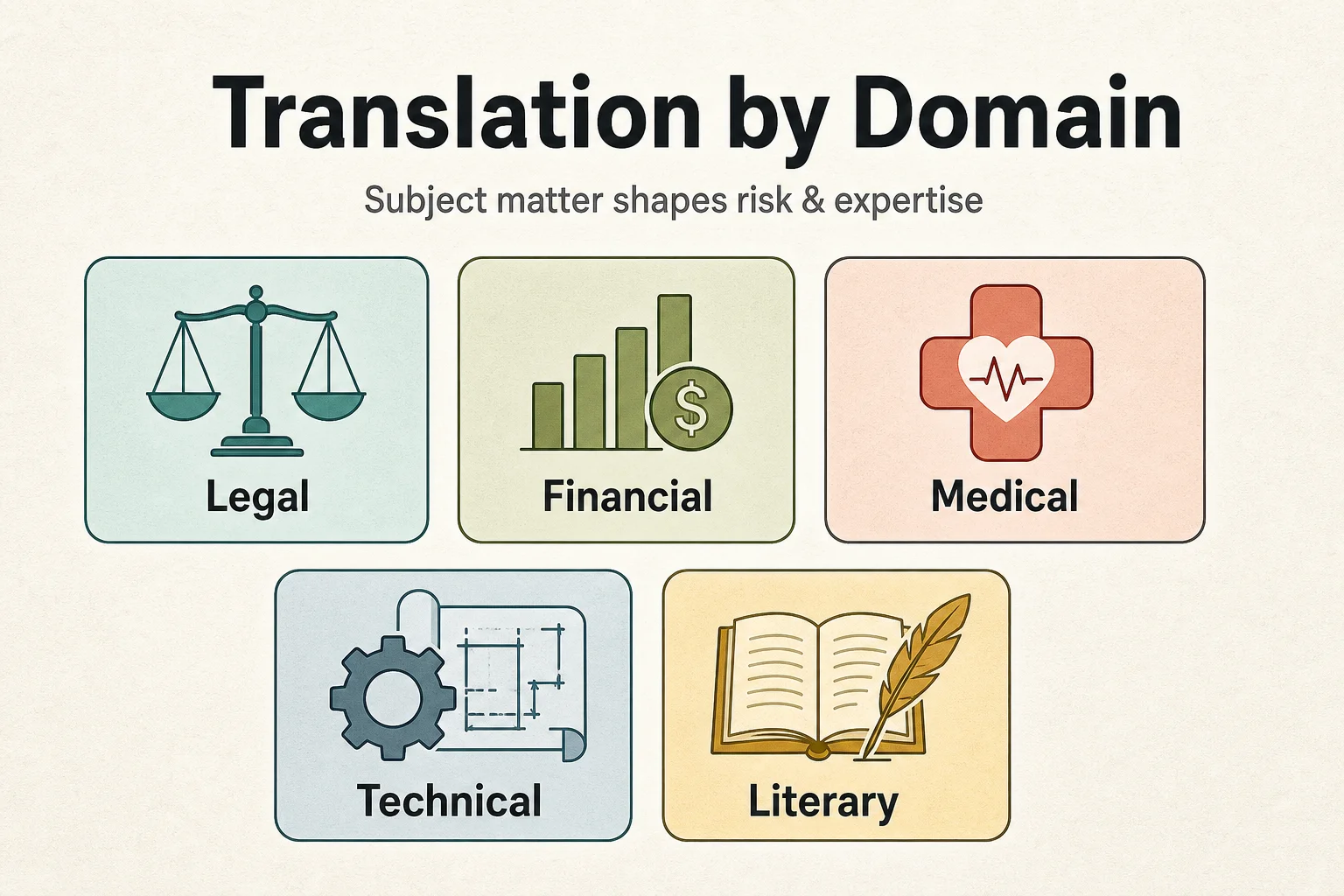
The most common way clients categorize translation is by industry, because each field has its own specialized terminology, regulations, and risk profile. Here are the major domains.
Legal, Judicial, and Certified Translation
Legal translation covers contracts, patents, terms of service, privacy policies, and court filings. Legal translation includes contracts, patents, and court documents, and precision in this domain prevents disputes, financial loss, and regulatory penalties. Accuracy in legal translation is crucial to avoid major repercussions - a small mistake in legal translation can lead to significant consequences, from voided agreements to lost cases.
Judicial translation occurs in court settings for legal documents - witness statements, judgments, depositions, and expert opinions used directly in proceedings. Juridical translation deals with binding legal instruments such as laws, regulations, and international treaties. Both require that legal translators must understand both legal and linguistic nuances, since legal concepts in one jurisdiction may have no direct equivalent in another.
Certified translation involves sworn or officially recognized certified translators who attest that the translation is accurate and complete. This is required for legal documents like birth certificates, immigration dossiers, marriage certificates, and academic transcripts. Country-specific practices vary widely: Spain and Brazil use sworn translators registered with official bodies; other jurisdictions require notary involvement; embassies, immigration authorities, and universities each have their own requirements for translating documents.
MT and LLMs can support research and drafting - for instance, summarizing a foreign-language contract's key clauses for internal review. But final versions submitted to courts, regulators, or government agencies almost always must be human-produced and/or carry a certified translation stamp. The stakes are simply too high: a deep understanding of both the source and target legal systems is non-negotiable.
Financial and Business Translation
Financial translation is one part of broader translation services for companies operating across markets, covering banking and corporate finance documents such as annual reports, balance sheets, prospectuses, fund factsheets, ESG reports, and investor presentations. Terminology consistency and numerical accuracy are paramount. A misplaced decimal, a confused accounting term, or an inconsistent rendering of IFRS-versus-GAAP terminology can mislead investors or trigger regulatory fines in financial documents.
Business translation extends more broadly to sales proposals, pitch decks, HR policies, internal newsletters, customer support scripts, and marketing materials. These documents typically carry lower regulatory risk than financial translation but still demand brand consistency and cultural adaptation. Translating a neobank's mobile app into Indonesian and Vietnamese, for example, involves not just language but UX conventions, payment terminology, and local customs around formal address.
Contemporary hybrid workflows are common here. Teams run initial MT or LLM translation in tools like MixTranslate, then have in-house finance staff or specialized linguists review the output using term bases that lock in approved financial terminology. This approach balances cost and speed against the accuracy demands of global expansion strategy: IFRS-based 2025 reports prepared for listings in both London and Hong Kong, for instance, benefit from MT-generated first drafts that domain experts then verify line by line.
Medical and Life Sciences Translation
Medical translation involves sensitive, high-accuracy documents where the stakes could not be higher. Patient leaflets, hospital discharge summaries, informed consent forms, clinical trial protocols, and regulatory submissions to agencies like the EMA or FDA all fall under this umbrella. Medical translation requires adherence to safety and industry standards - misinterpreting dosage, contraindications, or trial eligibility can endanger lives or invalidate entire studies.
Life sciences translation extends to biotech research papers, device user manuals, pharma training materials, and public health campaigns. Vaccine information updates, COVID-19 communication materials, and emergency health advisories have all demanded rapid, accurate translation into multiple languages since 2020.
Regulatory and terminology constraints are strict. Translators must work with MedDRA and ICD codes, follow local labeling laws, meet ethics committee requirements, and ensure readability in patient-facing documents. A 2025 study evaluating MT quality for medical texts found that engines like DeepL, GPT-4, and Google Translate achieved median BLEU scores of roughly 0.23–0.36 and COMET scores around 0.90 - indicating generally high alignment but persistent granular issues with specialized terminology.
Back translation checks accuracy by translating back into the original language, and this technique is standard practice in clinical trial documentation, where regulators need proof that the translated text faithfully represents medical records and protocols.
MT and LLMs are useful for researcher gisting and internal collaboration, but patient-facing or published materials require expert human translators with medical backgrounds and strict multilevel review.
Technical, Scientific, and Software Translation
Technical translation focuses on engineering, IT, and manufacturing documents - user manuals, installation procedures, engineering specs, safety data sheets, and product documentation. Technical translation requires expertise in specific subject areas, and it focuses on conveying specialized information accurately and clearly. Technical translation includes user manuals and scientific papers, and terminology management is essential for technical translation accuracy. Inaccuracies in technical translation can affect product safety - a mistranslated maintenance instruction in an aircraft manual, for example, could have catastrophic consequences.
Scientific translation is a related sub-area covering research articles, conference papers, theses, and lab reports in disciplines from physics to computer science. These texts demand not just language proficiency but a deep understanding of domain-specific conventions, citation norms, and technical documents structure.
Software localization involves translating UI strings, error messages, in-app help, release notes, and API documentation. The challenges are unique: dense terminology must stay consistent across screens, references to standards (ISO, IEEE) must be accurate, and character limits in UI elements impose hard constraints on the translated text. A Japanese button label, for example, may need to be significantly shorter than its English equivalent.
Workflows for technical translation typically combine CAT tools (for translation memories and term bases) with LLM variants tuned for technical style. Platforms like MixTranslate let teams test how different models handle formal Japanese UI text versus plain-English help content, then lock in the preferred output for consistency across releases. This is where technical documentation teams save the most time without sacrificing the translation quality that end users depend on.
Literary Translation
Literary translation stands apart from every other domain because style, rhythm, and voice matter as much as meaning. Translating novels, short stories, poetry, plays, and literary texts requires capturing style and tone of original works - the narrator's cadence, the weight of a metaphor, the surprise of a pun.
The challenges are formidable. Recreating rhyme and meter in poetry means making choices that reshape the text. Preserving narrative voice across 400 pages demands consistency no algorithm currently matches. Handling dialect, slang, and wordplay requires literary skills that go well beyond bilingual fluency. Literary translation requires proficiency in both languages and literary skills of a high order, which is why literary translators often function as co-authors - making interpretive choices, sometimes adding footnotes or paratext to explain cultural references that have no equivalent in the reader's own language.
Real-world examples highlight the stakes. Different English translations of Haruki Murakami or Elena Ferrante have sparked heated debates among readers and critics. Competing English versions of classics like "The Iliad" and "Don Quixote" each offer distinct readings shaped by their translator's era and sensibility.
MT and LLMs have been used experimentally as drafting tools for literary work, but current limitations are significant. Models tend to flatten voice, miss irony, and strip dialect of its texture. Ethical concerns also arise: who holds creative credit? For now, literary translation remains the most human-dependent domain, and specialized translation in this field focuses on artistry as much as accuracy.
Types of Translation by Format and Media
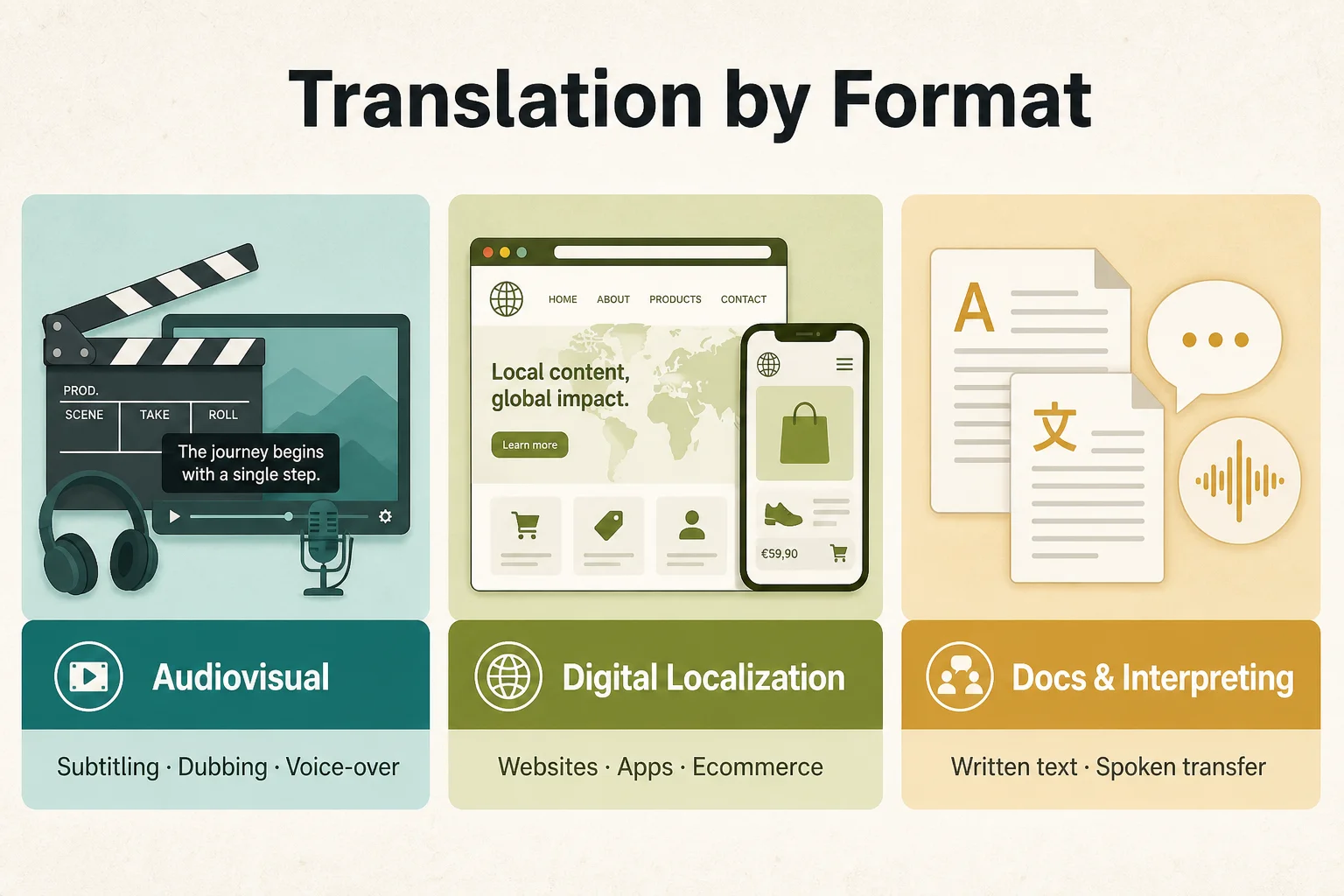
Some types of translation are defined less by subject than by the medium they live in - screens, video, and audio each impose their own technical constraints on the translation process.
Audiovisual Translation: Subtitling, Dubbing, and Voice-Over
Audiovisual translation covers translation for film, TV, streaming platforms, YouTube, podcasts, and video games. Audiovisual translation includes subtitling, dubbing, and voice-over, and each mode brings distinct constraints.
Subtitling places on-screen text that viewers read in real time. Subtitlers must manage reading speed (typically 12–17 characters per second), timecodes, and limited screen space. Dialogue is condensed to preserve meaning and tone while fitting within two-line limits. Subtitling a K-drama for Netflix, for instance, requires not just accurate translation but sensitivity to cultural nuances in honorifics, humor, and social hierarchy.
Dubbing replaces the original spoken language with voice actors performing in the target language. Lip-sync accuracy, casting choices, and voice performance all matter. When a globally released animated film is dubbed into 30+ languages, each version must feel native while matching mouth movements. This is where audiovisual translation includes subtitling and dubbing for media at its most technically demanding.
Voice-over layers narration over the original audio, common in documentaries and news programming. Lip-sync is less strict, but tone, pacing, and emotional register remain crucial.
Website, App, Ecommerce, and Localization Translation
The localization process goes far beyond literal translation. Localization adapts a product for a specific target culture, and localization includes changing currencies, formats, and cultural references alongside the words themselves. Software localization for a German Shopify store, for example, means adopting formal "Sie" address, adjusting legal disclosures, converting measurement units, and restructuring checkout flows.
Key content types within this category include website translation (landing pages, blog posts, FAQs, SEO titles, and meta descriptions), app translation (menus, buttons, onboarding flows, notifications), and ecommerce translation (product titles, bullet lists, reviews, size charts, checkout fields).
SEO plays a critical role. Translating and localizing keywords, URL slugs, headings, and alt texts for the target language can make or break organic visibility. The right keyword for Spain may differ substantially from the right keyword for Mexico, even though both target languages are Spanish.
Practical examples abound. Localizing a Shopify store for Germany and France means adapting payment terms, shipping options, and return policies to local norms. A Japanese market entry requires rethinking tone - shifting from informal US English to the layered formality that Japanese users expect in a global audience-facing interface.
Content teams use tools like MixTranslate to quickly generate multiple candidate translations for product pages or UI strings. They compare outputs from different LLMs, then choose the version that best fits brand voice, SEO goals, and local customs - turning what used to be a week-long process into an afternoon decision.
Other Types and Related Services
A few categories sit outside the main classifications but round out the picture for readers planning real projects.
General and NGO Translation
General translation covers everyday content without heavy jargon - news articles, blog posts, personal emails, simple brochures, and basic app descriptions. It is the broadest category and often the first type people encounter when they need to understand or share content across a foreign language barrier.
Specialized translation, by contrast, demands domain expertise. Legal, financial, medical, engineering, and academic content each carries its own risk profile and terminology requirements. The gap between general and specialized is significant: a blog post can tolerate a slightly awkward phrase, but a human-rights legal brief cannot.
NGOs and international audiences often require both. A climate-focused NGO might need general outreach materials for social media alongside specialized reports on emissions targets for UN review. Emergency response guidelines distributed after natural disasters must be translated rapidly into multiple languages with extreme care for clarity - lives depend on whether a community understands evacuation instructions in their own language.
For budget-constrained organizations, MT and LLMs plus careful human review can dramatically expand reach. But sensitive messaging - especially content involving medical records, legal protections, or vulnerable populations - still needs expert oversight. The cost of a misleading translation in humanitarian communication is not just reputational; it can be measured in harm.
Interpreting: Spoken vs. Written Language Transfer
Translation deals with written text; interpreting handles spoken language (or signed language) in real time. The confusion between them is common, but the skill sets diverge sharply.
Simultaneous interpreting happens in real time - at the UN, EU Parliament, or live conferences - with the interpreter speaking just seconds behind the source. Consecutive interpreting involves the speaker pausing while the interpreter renders each segment, common in press conferences, business meetings, and medical consultations. Whispered interpreting (chuchotage) serves a small number of listeners in a larger meeting. Remote interpreting via video platforms boomed after 2020 and has become standard for international audiences in hybrid events.
Skill requirements go beyond language: rapid comprehension, structured note-taking, public speaking ability, and emotional resilience are all essential. Interpreters perform linguistic and cultural translation in real time, a task no current algorithm handles reliably for high-stakes settings.
MT and LLMs now power speech-to-text and live captioning tools - Google's Gemini 3.5 Live Translate delivers speech-to-speech translation across 70+ languages. But professional interpreters remain crucial where nuance and confidentiality matter, such as asylum interviews and high-stakes diplomatic negotiations. Sight translation - delivering a written document orally in another language - also belongs to this space, bridging written and spoken language transfer.
Translation Technology: CAT Tools, TMS, and Quality Metrics
Modern translation technology underpins nearly every professional workflow. Computer assisted translation uses tools to store translated segments for consistency, enabling translators to reuse approved phrasing across projects via translation memories, term bases, concordance search, and automated QA checks.
A translation management system handles end-to-end workflow: assignment management, review stages, versioning, and integration with content management systems, help desks, and ecommerce platforms. Together, CAT tools and TMS ensure that translation agencies and in-house teams maintain consistency as projects scale.
Quality metrics have evolved alongside the technology. BLEU remains widely used, measuring n-gram overlap with reference translations - easy to compute but punishing of acceptable rewordings. METEOR adds synonym matching and recall-precision trade-offs. COMET, a neural metric first presented at WMT 2020, combines source and reference inputs trained on human judgments and shows higher correlation with human assessments than older metrics. In medical-text evaluations, COMET scores reached approximately 0.90 even when BLEU and METEOR showed more modest variation.
LLM platforms like MixTranslate layer on top of these concepts. Quality scoring, side-by-side engine comparison, and tone/style controls let teams make informed decisions about translation quality without needing a linguistics degree. A company localizing a product launch can use a TMS for workflow management and MixTranslate to compare three or four model outputs per key page, then lock in preferred terminology for all future updates.
How to Choose the Right Type of Translation for Your Project
With so many different types of translation available, the decision comes down to a few practical variables. Here is a simple mental checklist.
Audience: Who will read or hear this content? A global audience of consumers has different tolerance for imperfection than a panel of regulatory reviewers.
Risk level: What happens if the translation is wrong? High-risk legal, medical, or financial content demands human specialist work, possibly certified translation. A small mistake in a contract or clinical protocol can lead to significant consequences.
Regulatory requirements: Does the content need sworn certification, notarization, or compliance with standards like MedDRA or IFRS? If yes, human production and verification are required.
Budget and speed: Large-volume, lower-risk content - internal documentation, product descriptions, support articles - is well suited to machine or LLM translation with selective human review. High quality translation for publication or public campaigns may need full human or hybrid workflows.
Long-term value: Will this content be reused, updated, or referenced over years? Investing in proper terminology management and a translation management system pays off as language pairs multiply.
Tools like MixTranslate help in early stages: testing tone variants, comparing literal vs. free renderings across different LLMs, and prototyping style before committing to full human workflows. These options are complementary, not mutually exclusive. The most effective international audiences strategy documents its choices in a translation brief or style guide - so every team member, translator, or AI tool works from the same playbook.
Conclusion: Translation as a Strategic Capability in the AI Era
The taxonomy is broad: types differ by approach (human translation, machine translation, hybrid), by method (literal translation vs. free translation, creative translation, communicative translation), by domain (legal translation, financial translation, medical translation, literary translation, scientific translation, technical translation), and by format (audiovisual translation, software localization). Each serves a distinct purpose, and understanding them prevents costly mismatches.
In 2026, organizations that treat translation as a strategic capability - with defined processes, translation tools, and quality standards - gain a measurable edge in global communication and revenue. AI and LLM platforms like MixTranslate act as force multipliers, enabling more multilingual content and faster experimentation with tone and style while preserving the role of human expertise where it counts.
Looking ahead, as models improve and new languages and domains are added, translators, content teams, and AI will increasingly collaborate rather than compete. The winners will not be those who pick one approach over another, but those who know when to use each. Start mapping your content to the right type of translation - and let the right tools amplify your team's expertise.