Machine Translation Post Editing: How to Combine AI Speed with Human Quality
Machine translation delivers speed, but human editors deliver quality — MTPE gives you both. In this guide, we cover how machine translation post editing works, the difference between light and full post editing, and best practices for getting human-quality results at AI speed and cost.

Introduction to Machine Translation Post Editing (MTPE)
Machine translation post editing is the process where a machine translation engine generates a first draft, and human post editors refine it to publication-ready quality. Instead of translating from scratch, linguists start with machine generated translation and focus their energy on correcting, polishing, and adapting.
This isn't a new concept. Early institutional MT use dates back to the late 1970s, with organizations like the European Commission and Caterpillar adopting machine translation systems for internal documentation. What changed everything was the arrival of neural machine translation around 2016–2017, and more recently large language models, which dramatically improved raw output quality.
In 2026, the math is simple: exploding content volumes across support articles, technical documentation, UX copy, and 200+ language pairs make human-only workflows impractical. Machine translation post editing is essential for producing reliable multilingual content efficiently, and post editing is generally faster and less expensive than translating from scratch.
The rest of this article walks through MTPE types, workflows, tools like translation memories, and best practices for combining AI speed with human expertise.
What Is Machine Translation Post Editing (and How It Differs from Editing Human Translation)
Translation post editing MTPE starts with machine translation output - a raw, bilingual file produced by an MT or AI translation system - and then a human linguist edits it for accuracy, fluency, and style. The key distinction: work always begins from machine translated output, never from a blank page.
This differs from editing human translation in important ways. When editors review human work, they mostly polish style, tighten terminology consistency, and correct the occasional error. Post editing machine translation, by contrast, often requires fixing systematic errors, rewriting awkward phrasing, correcting omissions, and sometimes fully retranslating segments that the engine botched. The initial step in MTPE involves generating a raw automated translation via a machine translation engine, and the human effort scales from there.
Content types that frequently go through MTPE include product manuals, app UI strings, and internal support documentation. Machine translation can misinterpret technical jargon, idioms, or cultural context, so the intensity of post editing depends heavily on the language pair (e.g., Spanish to English versus Japanese to English), the domain (marketing materials versus technical documentation), and how well the machine translation engine handles that specific content. Post editing improves machine translation accuracy and fluency - it's a spectrum from quick fixes for spelling mistakes and mistranslations to deep stylistic work.
Light vs Full Post Editing: Two Levels, One Strategy
Industry practice and ISO 18587:2017 distinguish between light post editing and full post editing, matching post editing effort to business goals and budgets. Both levels require skilled post editors with subject-matter knowledge - the difference is in target quality, not who does the work.
The trade-off is straightforward: light post editing optimizes speed and cost for basic understanding, while full post editing aims at near-human quality suitable for publication under your brand voice. Many companies mix both levels in one program - light MTPE for internal help-center articles, full MTPE for landing pages and customer-facing email campaigns.
Quality standards are essential for effective post editing. You should define clear quality guidelines to ensure consistent post editing results. Specifying which level applies to each content type upfront prevents over editing or under-editing, and it belongs in your project instructions or style guide.
Light Post Editing
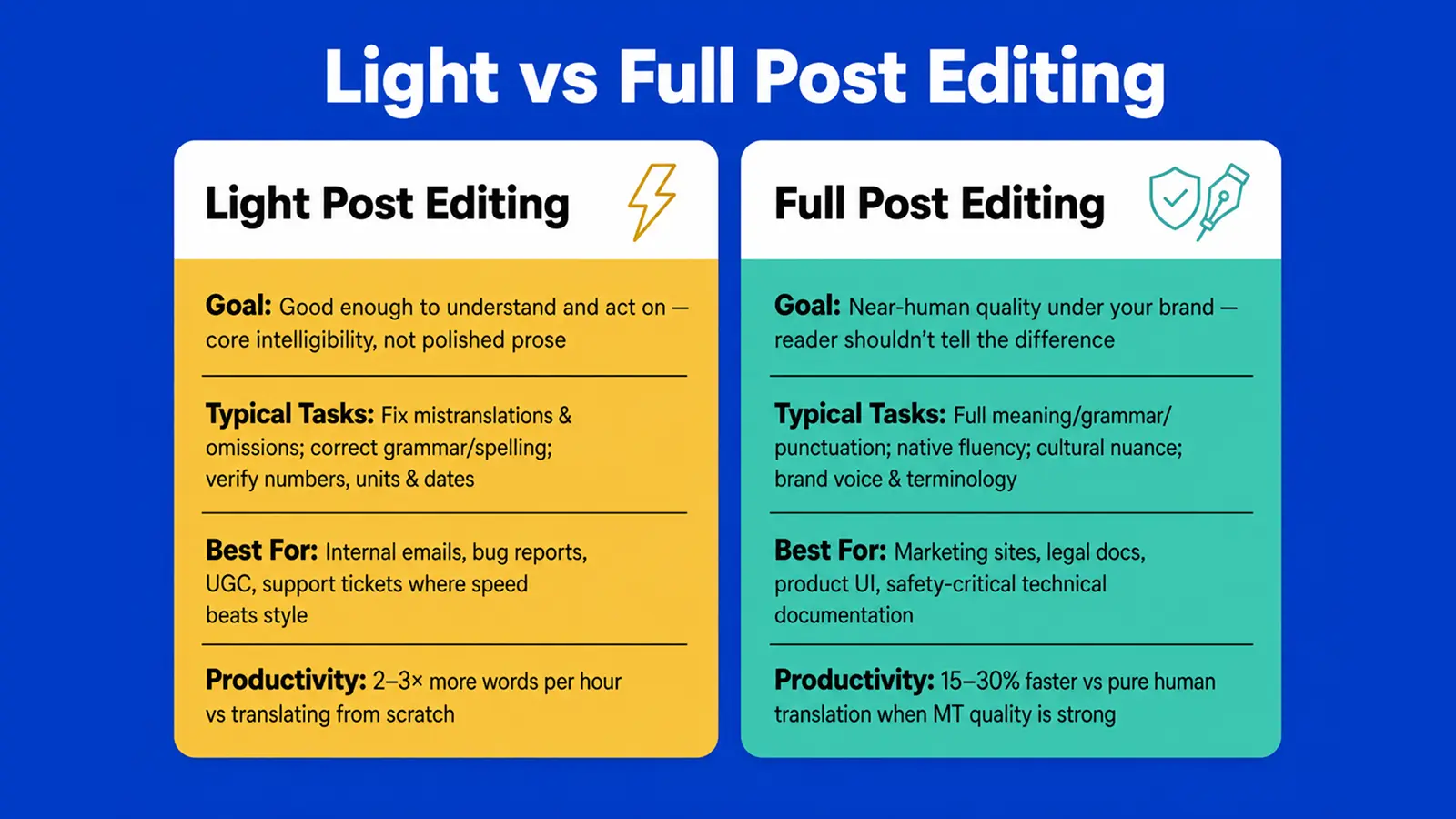
Light post editing focuses on core intelligibility and factual accuracy, leaving minor style issues untouched. The goal is "good enough to understand and act on," not polished native-level prose.
Typical interventions include:
- Fixing mistranslations and omissions
- Correcting obvious grammatical errors and spelling mistakes
- Ensuring numbers, units, and dates are accurate
- Repairing sentences that are completely confusing or grammatically incorrect
Light post editing corrects major errors for basic readability. Concrete use cases include internal emails, bug reports, user-generated content, and support tickets where speed matters more than style.
Light post editing allows processing 2–3 times more words per hour compared to translating from scratch, especially when MT quality is decent and content is repetitive. For high-volume internal content, this productivity multiplier is significant.
Full Post Editing
Full post editing brings raw machine translation up to a standard comparable to high-quality human translation, suitable for external publication under your brand name. Full post editing aims for quality comparable to human translation - the reader shouldn't be able to tell the difference.
Typical tasks include:
- Correcting meaning, grammar, and punctuation completely
- Ensuring natural flow and native-level fluency
- Adapting cultural nuances and idioms for the target language
- Aligning tone with brand voice and preferred terminology
- Verifying formatting and tags
Full post editing improves style, tone, and cultural appropriateness. Use cases include marketing websites, legal documents, product UI text, and safety-critical technical documentation. Full post editing can increase productivity by 15–30% versus pure human translation when MT is strong. However, for some low-resource language pairs or highly creative content, translating from scratch may still be more efficient.
Why Use MTPE? Benefits and When It Makes Sense
MTPE is a hybrid approach that blends machine speed with human expertise to hit realistic budgets and deadlines without compromising quality. Post editing improves translation quality by combining speed and human accuracy.
The main benefits:
- Faster turnaround vs. traditional translation workflows
- Cost savings of 30–50% for major language pairs
- Terminology consistency via translation memories and glossaries
- Better quality vs. raw output from any single AI translation engine
Translation memory accelerates the post editing process and reduces post editing effort for repetitive content. MTPE supports scale - thousands of SKUs, weekly app releases, or continuous localization streams where fully human workflows would bottleneck.
It also simplifies multilingual content refreshes. Updating a 2019 technical manual for a 2026 product version? Reuse translation memories for unchanged segments, apply MTPE to changed ones, and only translate from scratch where needed.
Decision hint: If you have large volumes, clear specialized terminology, and flexible audience expectations, MTPE is usually a strong candidate. If you need highly creative copy or confidential legal documents with zero tolerance for error, lean toward human-only translation work.
MTPE Workflow: From Pre Editing to Human Post Editing and QA
A clear workflow matters more than which specific machine translation engine you pick. Translation Management Systems automate the post editing workflow, but you need to define the stages first.
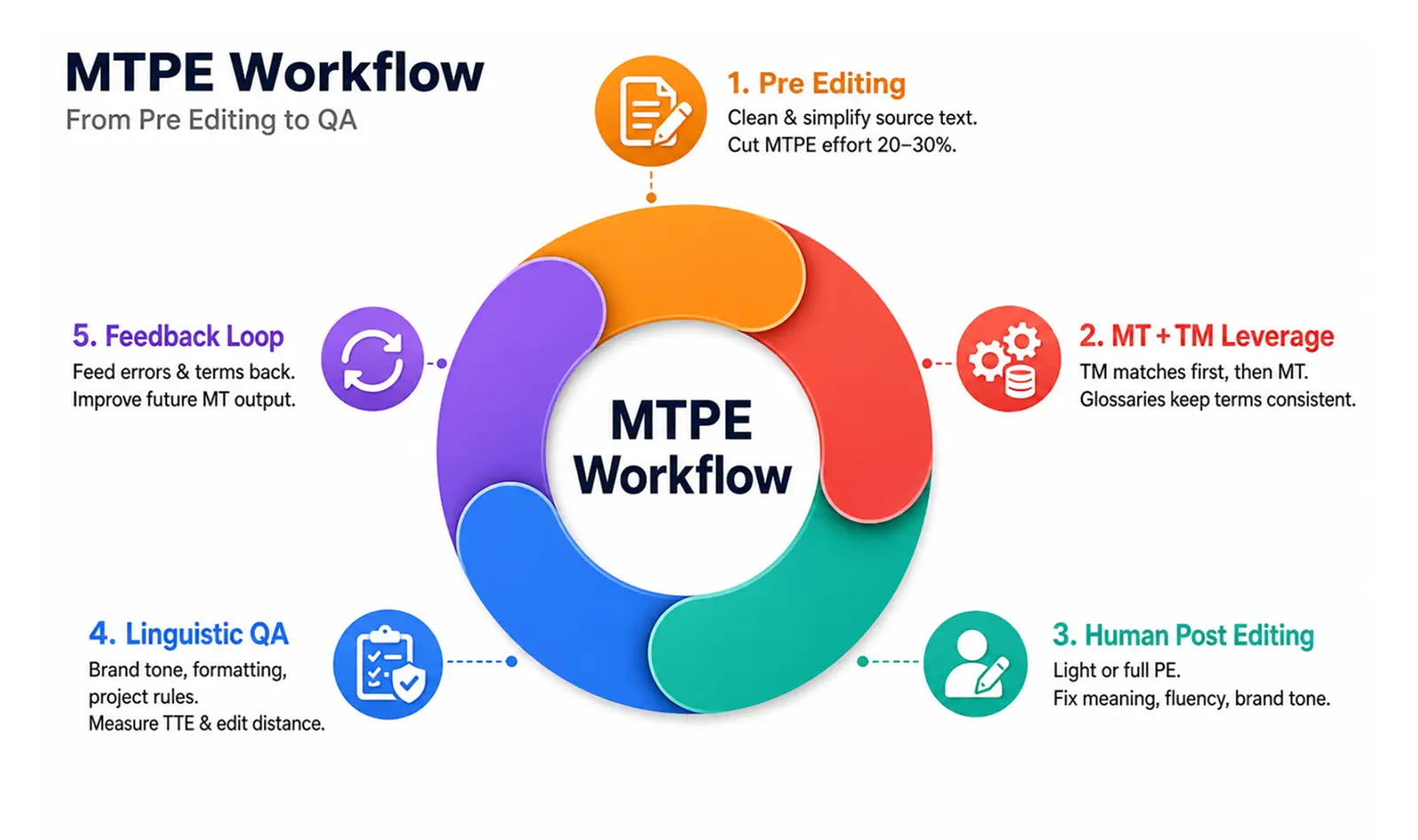
The main stages in order:
- Pre editing of source text
- MT and translation memory leverage
- Human post editing (light or full)
- Linguistic QA
- Feedback loop to improve future mt output
In a modern setup, these stages happen inside one environment - a TMS, CAT tool, or a platform like MixTranslate for the MT evaluation phase - to avoid file chaos. Documenting decisions during the post editing process (how technical terms are translated, which style level applies) keeps future updates consistent.
Pre Editing: Preparing Better Source Text for MT
Pre editing means cleaning and simplifying source text before sending it to a machine translation engine, reducing downstream post editing effort through process optimization.
Concrete actions:
- Remove ambiguous pronouns and clarify references
- Standardize specialized terminology in the source
- Split complex sentence structures into shorter, clearer sentences
- Fix existing typos, formatting issues, and inconsistent technical terms
Pre-editing the source text can reduce common machine translation errors. High-quality source text reduces post editing effort by 20–30%, which compounds across every language pair you target. Companies with style guides and controlled authoring rules naturally produce better MT output and lower MTPE costs.
Using Machine Translation Engines and Translation Memories Together
Translation memories store previously validated human translations and should be used alongside mt engines to avoid redoing work. Using glossaries ensures consistent terminology across translations and prevents drift in approved terminology.
A typical priority order: 100% and high-fuzzy TM matches first, then MT for new or low-match segments. For example, an EN–FR software manual might yield 60% of segments from translation memory, 30% from machine translation, and 10% needing from-scratch translation due to product changes.
Modern tools blend MT with translation memories and glossaries so that post editors see all suggestions side by side for each machine translated segment. This setup preserves preferred terminology while leveraging machine speed for new content.
Human Post Editing and Linguistic QA
In the post editing stage, human linguists go segment by segment, improving machine translated text according to the defined light or full level. Post editors verify cultural appropriateness and context that machine translations often miss. Post editors should be trained to recognize common neural machine translation errors like hallucinations, omissions, and over-literal phrasing.
A typical editor's screen in a CAT tool shows source text, MT suggestion, TM hits, glossary terms, and QA warnings - all visible at once, allowing the human editor to correct errors and refine wording efficiently.
Linguistic Quality Assurance (LQA) focuses on key quality areas: expert human review for brand tone, formatting compliance, and project-specific rules. Error typologies help identify recurring issues in translations and provide insights for refining MT engine training. Time to Edit (TTE) measures editing efficiency and MT quality, while lower edit distances indicate higher machine translation quality.
Tools and Platforms That Make MTPE Work
Translation technology doesn't replace human expertise - it amplifies it. The essential tools for MTPE fall into clear categories:
- Machine translation systems (including LLM-based mt models and traditional mt systems)
- Translation memories for reuse of validated translations
- Term bases and glossaries for terminology consistency
- CAT tools that centralize machine output, TMs, and glossaries
- QA checkers for automated error detection
CAT tools manage repetitive tasks and quality checks in MTPE, making it easier for post editors to work without switching apps. Quality Assurance tools catch errors in post-edited content - flagging spelling mistakes, missing numbers, tag inconsistencies, and incorrect glossary usage that human editors then verify.
MixTranslate fits into this ecosystem by letting users compare outputs from 20+ AI translation models, see quality metrics, and move the best candidate into their CAT or TMS for human post editing, making it easier to evaluate DeepL alternatives and other MT tools in one place. This upstream comparison step can meaningfully reduce downstream editing time.
Prioritize integrations: mt engines and translation memories should be directly available inside your editors' primary tools to reduce manual copy-paste and avoid introducing new errors.
Quality, Language Pairs, and Cultural Nuances
MT quality varies widely across every language pair and domain, so post editing effort must be adjusted accordingly. A 2026 study of 90 million words found MTPE was 66% faster on average than human translation - but EN→FR saw +130% gains while EN→SV was actually 7% slower.
For high-quality engines and well-documented domains like IT documentation, light post editing may be enough. For under-resourced languages or highly specialized content, full post editing or human-only translation from a professional translator is often safer. The human effort required scales with MT weakness.
Cultural nuances remain a persistent challenge. Machine translation produces literal output that frequently mishandles idioms, politeness levels, gender and formality choices, and region-specific references. Effective MTPE methods improve fluency and style to align with the target audience, but only when post editors are native-level speakers culturally embedded in the target market.
Post editing contributes to continuous improvement of machine translation quality through feedback. Measuring quality continuously provides insights into where machine translation performs well or needs improvement. Consistent translation quality across language pairs requires centralized style guides, shared glossaries, and regular reviews of both machine generated output and human post performance data.
Best Practices for Effective MTPE Programs
Here's a practical checklist for teams building or improving MTPE workflows, whether you're a small content team or a large localization program with dedicated project managers.
Train your people. Training post editors improves translation quality and reduces proofreading time. Focus on MT-specific skills: recognizing engine error patterns in machine translation produces, avoiding unnecessary rewrites, and working efficiently with CAT tools. Human translators transitioning into post editing services need this specialized training.
Document everything. High-quality source content, style guides, terminology lists, and clear definitions of light vs full post editing for each content type ensure consistent final delivery and reduce guesswork.
Measure what matters. Set up metrics like edit distance, Time to Edit (TTE), and quality scores per language pair. Tracking TTE helps evaluate the ROI of mt systems. Regular evaluations improve MTPE performance and quality, and regular quality assessments improve post editing consistency. Regular evaluations of MTPE performance help identify areas for improvement.
Run pilots before scaling. Compare cost, speed, and overall quality for human-only, MTPE, and raw machine translation on representative content. Use real data - not assumptions - to choose the right model.
Protect privacy. Avoid sending confidential information to unsecured public MT tools. Platforms like MixTranslate emphasize privacy and do not train models on user data, which matters for specialized content in regulated industries.
Conclusion: Positioning MTPE in Your Translation Strategy
Machine translation post editing is a strategic middle ground between raw AI output and full human translation - especially valuable for recurring, large-volume translation post projects. It's not about replacing human expertise; it's about directing it where it matters most.
Success depends on matching MTPE level to content purpose, investing in training and tools, and monitoring performance per language pair and domain. Modern platforms like MixTranslate can be used upstream to test multiple AI translation engines, compare machine output, and select the best baseline for post editing, maximizing what human editors accomplish with their time.
As MT and generative AI continue improving, the role of the professional translator will keep shifting - from typing translations to supervising quality, managing cultural nuances, and designing better workflows.
Start by reviewing your current processes. Identify one pilot area - support articles, technical documentation, or knowledge base content - where MTPE could safely cut costs and turnaround time without sacrificing the quality your audience expects.