How Accurate Is Google Translate in 2026? (Infographics Included)
Google Translate has come a long way since its early days - but is it accurate enough for your needs right now? The answer depends on what you're translating, which languages you're working with, and how much is at stake. This guide breaks down where Google Translate performs well, where it falls short, and when you should look for stronger alternatives.

Quick answer: how accurate is Google Translate today?
In 2026, how accurate is Google Translate? For many common language pairs - particularly major European languages and widely spoken languages like Spanish, Chinese, and Japanese - Google Translate typically preserves 80–90% of sentence-level meaning in straightforward content. But accuracy drops sharply, sometimes below 60%, for low resource languages or highly specialized text.
Google Translate's accuracy varies depending on the language pair and content type. Since December 2025, Google Translate has been powered by Gemini models for text translation across nearly 20 major languages. Since June 2026, it includes Gemini 3.5 Live Translate for near real-time speech-to-speech in 70+ supported languages - a significant leap from older systems.
Research puts hard numbers on this: Google Translate's accuracy ranges from 55% to 94% depending on language. Studies of medical discharge instructions showed Spanish translations at ~96% accuracy, Chinese at ~90%, and Russian at ~80%. For everyday content between high resource languages, it's fairly accurate. For contracts, medical instructions, or brand-critical marketing content, it's risky.
If you want to go beyond a single engine, MixTranslate lets you compare outputs from over 20 AI translation models - including Google-style MT and LLMs like ChatGPT, Claude, and Gemini - so you can pick or refine the most accurate translation for your specific needs.
What is Google Translate, and how has it evolved since 2006?
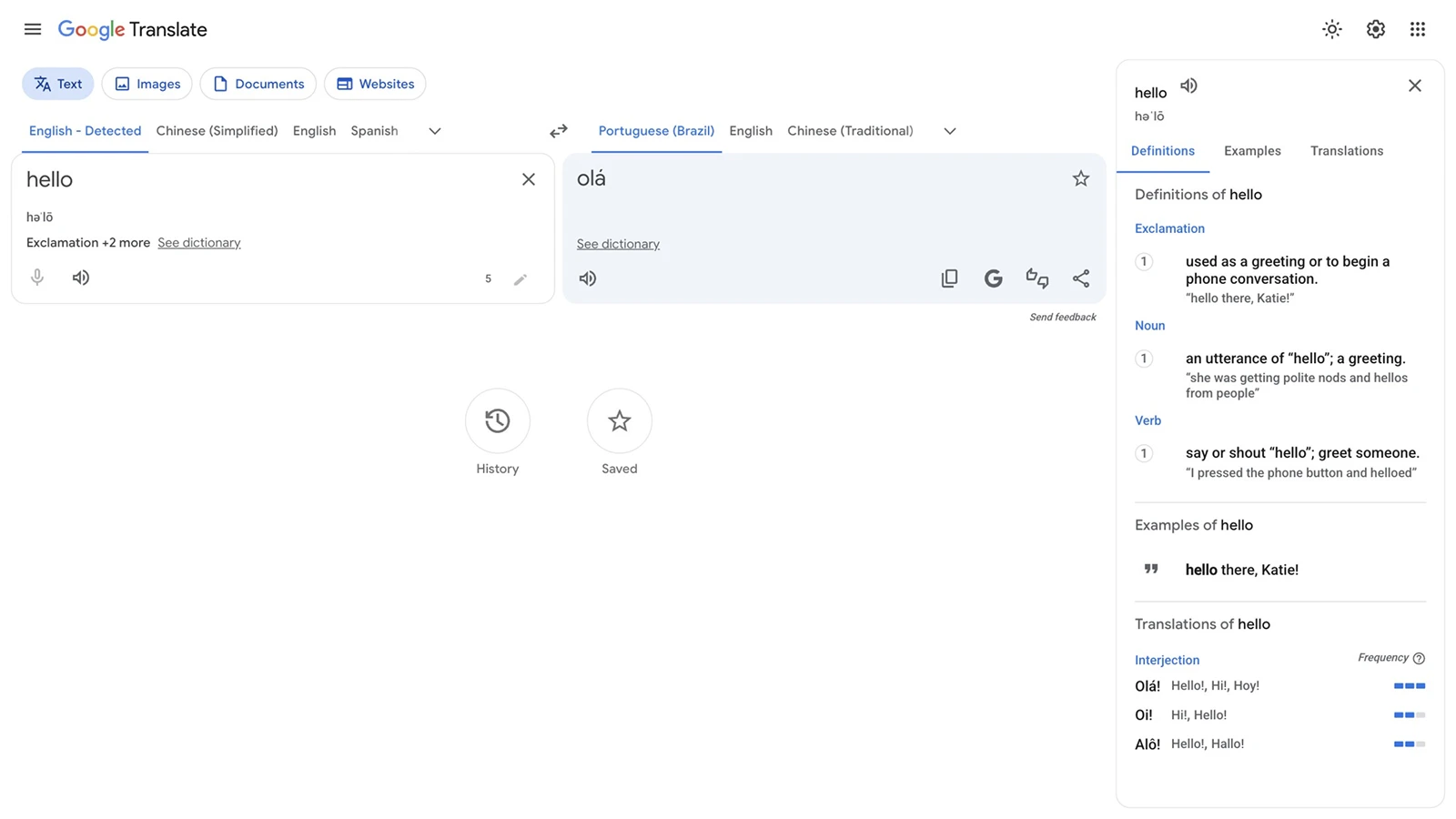
Google Translate launched in 2006 as a free web-based translation tool and now supports direct translation between over 130 languages across web, Android, iOS, Chrome, and Gmail. Machine translation systems like Google Translate improve over time, and the evolution here has been dramatic.
The early era (2006–2016) relied on statistical machine translation - phrase-based systems trained on corpora like Europarl and large web crawls. These were decent at word order and common translations but clumsy with complex sentences and long-range dependencies.
In 2016, Google introduced neural machine translation technology with GNMT, translating whole sentences using deep neural networks. This single shift cut translation errors by 55% to 85% for many high-resource pairs. The Transformer model was introduced in 2018 to improve accuracy further, enabling more sophisticated attention to sentence structure and context.
The biggest recent change -- LLM abilities: in December 2025, Google rolled out Gemini translation capabilities to Google Translate for text in nearly 20 languages (English, Spanish, Hindi, Chinese, Japanese, German, and more) on web and mobile, with speech-to-speech translation entering beta. Then in June 2026, Google announced Gemini 3.5 Live Translate, a near real-time speech-to-speech system rolling out via the Gemini Live API, Google AI Studio, private preview in Google Meet, and gradually in the Google Translate app.
Despite these advances, Google Translate remains machine translation software - not human translation - and still has meaningful limits in cultural context, nuance, and specialized fields.
How does Google Translate work under the hood?
Google Translate is a neural machine translation system trained on massive amounts of parallel text and user feedback. It uses artificial intelligence to predict the most likely translation of a sentence - not simply looking up words in a dictionary.
The training data includes bilingual corpora from government documents, open web pages with aligned multilingual content, and anonymized user corrections. How much data is available matters enormously: coverage is far richer for English and other languages like Spanish or French than for non English languages with smaller digital footprints.
Here's how google translate work at the sentence level: models encode the entire source language sentence into a vector representation, then decode it into the target language word by word, using attention mechanisms to decide which source words matter for each output token.
Since 2025, Gemini-based models blend classic MT with large language model capabilities. This improves handling of longer context, more natural phrasing, and some implicit world knowledge - though the system remains imperfect, especially with idiomatic or creative text.
The modality also matters. Text-to-text translation benefits from full sentence context. Speech-to-speech (like Gemini 3.5 Live Translate) adds layers - voice recognition, segmentation, deciding when to translate - where small errors compound through the pipeline.
Google also uses automatic quality estimation and user signals (e.g., "Was this translation helpful?" or alternative suggestions) to refine translations over time across multiple languages.
What do studies say about Google Translate's accuracy?
"How accurate is Google Translate" has been studied across academic, medical, and industry settings, often with different metrics and methodologies.
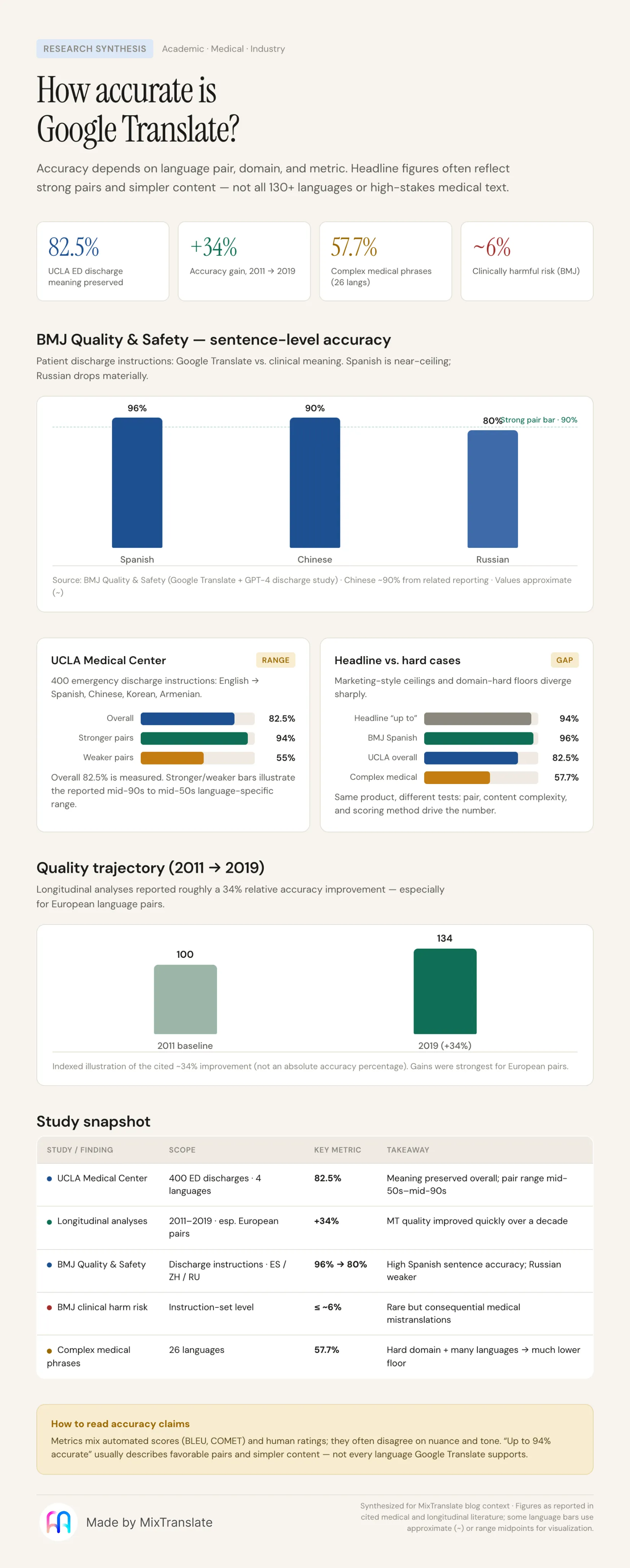
A widely cited UCLA Medical Center study examined 400 emergency department discharge instructions translated from English into Spanish, Chinese, Korean, and Armenian. Overall, 82.5% of translations preserved the intended meaning, with language-specific translation accuracy ranging roughly from the mid-50s to mid-90s depending on the pair.
Earlier longitudinal analyses showed about a 34% improvement in accuracy between 2011 and 2019, especially for European language pairs - illustrating how fast machine translation quality has been advancing.
More recent findings from BMJ Quality & Safety evaluated Google Translate alongside GPT-4 for patient discharge instructions across Spanish, Chinese, and Russian. Sentence-level accuracy was high for Spanish (~96%) but dropped to ~80% for Russian, with potential for clinically harmful mistranslation at up to ~6% at the instruction-set level.
An older but important finding: Google Translate is 57.7% accurate for complex medical phrases when tested across 26 languages - a reminder that headline numbers like "up to 94% accurate" typically refer to certain language pairs and simpler content, not all 130+ tested languages. Accuracy metrics can be based on automated scores (BLEU, COMET) or human ratings, and these often disagree, especially for nuance and tone.
How does accuracy vary by language pair?
Google translate accuracy is not uniform. High resource languages with abundant training data and active user feedback perform far better than low resource languages with limited digital content.
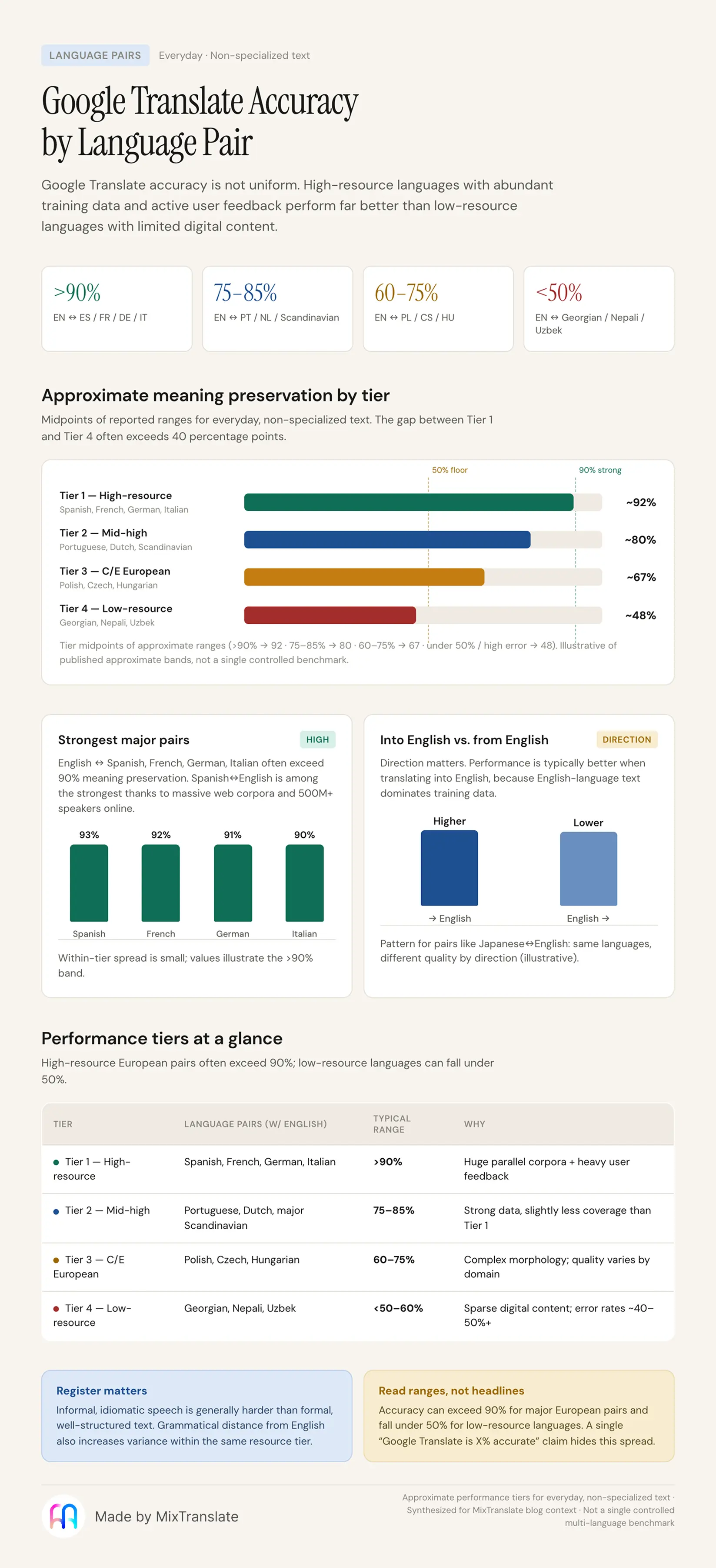
Here are approximate performance tiers for everyday, non-specialized text:
- English ↔ Spanish, French, German, Italian: Often >90% meaning preservation. Spanish to English translations are over 90% accurate, making this one of Google Translate's strongest major language pairs thanks to massive web corpora and over 500 million speakers contributing online content.
- English ↔ Portuguese, Dutch, major Scandinavian languages: Frequently in the ~75–85% range for general translation tasks.
- English ↔ Central/Eastern European (Polish, Czech, Hungarian): Can drop to ~60–75% depending on domain and sentence complexity.
- English ↔ low-resource or morphologically complex languages (Georgian, Nepali, Uzbek): Much less reliable. Accuracy drops sharply for low-resource languages like Georgian, and accuracy drops significantly for low-resource languages like Nepali, with error rates approaching or exceeding 40–50%.
Translation accuracy can be very high for common European language pairs, while high-resource languages often reach accuracy rates exceeding 90%. But accuracy can range from over 90% for major languages to under 50% for low-resource languages.
A few additional factors:
- Language direction matters. Translation performance is better when translating into English, since English-language articles dominate training data. English→Japanese vs Japanese→English can yield noticeably different quality.
- Register matters. Translation accuracy can fluctuate for languages with different grammatical structures compared to English. Informal, idiomatic speech is generally harder than formal, well-structured text.
Content types: when is Google Translate accurate, and when is it risky?
Even for the same language pair, how accurate google translate performs depends heavily on the type of content, register, and intent.
Where Google Translate is usually strong:
- Straightforward, literal content like menus, basic instructions, error messages, or FAQs
- Short emails or chat messages where stakes are low and small stylistic issues are acceptable
- Technical text with consistent terminology and simple sentence structures, especially between major European languages
Where Google Translate tends to struggle:
- Marketing content, slogans, and brand voice where tone and emotion matter as much as literal meaning
- Legal contracts, financial disclosures, and compliance documents where a single mistranslated term can change obligations
- Human-sensitive fields like medical instructions, police reports, asylum statements, and patient consent forms
Context and sentence complexity significantly affect translation accuracy. Google Translate struggles with idioms, metaphors, slang, and cultural nuances, and it struggles with informal language and slang translations. Accuracy is lower for specialized content such as legal or medical documents, and technical and medical documents lower the accuracy rate due to specialized vocabulary.
Real-world examples make the risk concrete: in one medical phrase study, "Your child has been fitting" translated into Swahili came back meaning "Your child is dead." Google Translate is less reliable for complex sentences and idioms, and incorrect translations in high-stakes settings can have serious consequences.
For high-risk content, human translation or at least professional machine translation post editing remains non-negotiable - even if the initial draft comes from Google Translate or another engine.
Google Translate vs human translation: where do humans still win?
While ai translation has advanced rapidly, human translation still outperforms machine translation in nuance, culture, and intent - especially beyond literal meaning.
Where human translators excel:
- Understanding implicit context, irony, sarcasm, and subtext
- Adapting tone and style to match brand voice or literary genre
- Handling sparse or ambiguous source texts by asking clarifying questions - something Google Translate cannot do
Professional human translators bring domain expertise in legal, medical, or technical fields. They can research terminology, cross-check regulations, and coordinate with stakeholders - activities outside the scope of any general MT system. Errors in source text quality negatively impact translation outcomes for MT, but a human can flag and fix source issues before translating.
A 2026 study on literary translation confirmed that Google Translate lost ground especially with literature, creative style, and metaphors - areas where native speakers and professional translators maintain a clear edge.
Humans are slower and more expensive, which is why many organizations in 2026 use "human in the loop" approaches: MT engines like Google Translate provide a draft, but final responsibility rests with a qualified translator or reviewer. For content where brand trust, legal clarity, or people's wellbeing are at stake, human post editing or full human translation remains the gold standard.
Comparing Google Translate with other machine translation tools
Google Translate is not the only major MT engine. Several competitors serve different target languages and use cases - and the "best" engine varies by language pair, domain, and content type.
- DeepL: Launched in 2017, focused on high-quality neural MT. DeepL supports over 100 languages and excels in Spanish translations. Comparisons show that DeepL often provides more natural translations for European languages, making it a strong choice for marketing or style-sensitive content across European language pairs.
- Amazon Translate: A cloud API service within AWS. Amazon Translate supports 75 languages and offers high no-touch translations, often used in backend translation workflows rather than as a consumer app.
- Microsoft Translator: Integrated into Office, Teams, and Azure. Microsoft Translator supports 111 languages and uses neural networks. Microsoft Translator performs comparably to Google Translate for commercial languages, making it popular in enterprise environments.
Many machine translation tools can deliver fluency and contextual quality, but accuracy varies across MT engines and language pairs. This is exactly where MixTranslate adds value: MixTranslate compares outputs from over 20 AI translation models - including Google, ChatGPT, Claude, Gemini, DeepSeek and others - letting you compare side by side, adjust tone, and choose the most accurate translation rather than relying on a single engine.
Or if you are looking for a more comprehensive comparison, you can read our blog: Best Google Translate Alternatives in 2026.
From machine translation to MT post-editing (MTPE)
Machine translation post editing is a workflow where human editors review and correct machine-translated content instead of translating from scratch. It's now standard practice for teams that need to scale multilingual content without sacrificing quality.
Why MTPE works: MT (including Google Translate) often gets the gist right but makes systematic errors - gender agreement, terminology misuse, and flattened tone - that a human can fix far faster than re-translating.
Typical MTPE levels:
- Light post-editing: Fix obvious mistranslations and critical errors so translated content is understandable and correct. Best for internal documentation or low-visibility use cases.
- Full post-editing: Refine style, fluency, and consistency until the output meets near-human quality. Essential for website translation, product descriptions, or knowledge base articles.
Studies show that only a fraction of MT output requires heavy editing in high-resource pairs, indicating that base MT quality has become strong enough for many low-risk use cases with limited human effort.
For business teams, the practical workflow looks like this: use Google Translate or other mt engines as a first pass, then rely on human editors or external linguists for key pages. Platforms like MixTranslate can feed the best MT output from multiple engines into an MTPE process, helping editors start from the strongest candidate translation rather than a single, fixed engine's output.
Privacy, data use, and limitations of Google Translate
Accuracy is not the only consideration. You also need to understand what happens to your text when you paste it into any translation tool.
Google's general approach: text sent to Google Translate may be logged and used in anonymized form to improve services and models, especially when using the free consumer interface. Google Cloud Translation offers stricter enterprise-grade options, but they require separate configuration and billing. It is not recommended to use Google Translate for sensitive data - whether that's patient records, legal drafts, financial data, or internal product roadmaps.
Functional limitations also affect quality:
- Input length caps mean long documents get translated sentence by sentence, losing document-level context
- No built-in custom glossary enforcement in the free app - translated articles may use inconsistent terminology
- Limited control over tone and style; the free version defaults to neutral output regardless of the same language pair's nuances
- Data extraction from images is possible but adds another error layer
MixTranslate's approach is designed with privacy in mind: translations are not stored or used for model training by default. It also offers terminology management, tone control, and transparent quality indicators so teams can decide when MT is enough and when human input is needed.
Always review the privacy policy and data processing terms of any MT solution you adopt, especially for regulated industries.
When should you use Google Translate, and when to look beyond it?
Here's a pragmatic framework. How accurate is google translate for your specific case? It depends on the stakes.
Low-risk, low-visibility - Google Translate (or similar MT) is usually fine on its own:
- Personal travel, menus, signs, everyday chat
- Internal notes, quick comprehension of foreign-language emails in your native language, or exploratory research
- Early drafts where accuracy can be checked later by a fluent speaker
Understanding of simple texts is generally good but not reliable for high-stakes translation.
Medium-risk, medium-visibility - MT plus light human review:
- Internal company documentation or support articles where some errors are tolerable but clarity matters
- Product descriptions on marketplaces where incorrect wording can hurt sales but isn't life-threatening
- Here, tools like MixTranslate that allow quick comparison across mt engines and light editing in one interface provide significant value
High-risk, high-visibility - professional translation or full MTPE required:
- Websites' main marketing pages, legal documents, healthcare instructions, law enforcement and immigration paperwork
- It is not suitable for high visibility or high importance content without human oversight, even if Google Translate is used for initial drafts
Google translate depends on many variables, and for teams building long-term strategies to scale multilingual content, relying solely on any single free MT app leaves gaps. Platforms like MixTranslate that combine multiple ai translation engines, custom tone, quality scoring, and solid privacy offer a more complete solution.
Conclusion: how accurate is Google Translate, and what's next?
Google Translate in 2026 - powered by GNMT, Transformer models, and Gemini upgrades - is one of the most capable general translation software tools available, often achieving above 80–90% accuracy for major language pairs and simple content. Google Translate performs impressively for everyday use across different target languages, and machine translation quality continues to climb.
But the limits are real. Uneven google translate accuracy across languages, challenges with cultural references, humor, creative text, and privacy concerns when using free consumer interfaces for sensitive information mean it's not a universal solution. Accuracy varies by language, domain, and content format.
The best results in 2026 come from combining machine translation with human judgment - either via machine translation post editing workflows or tools that give users more control. MixTranslate's multi-engine comparison, tone control, and terminology support help you find accurate translations faster, whether you're working with common language pairs or other languages where a single engine may fall short.
Treat AI translation as a powerful assistant, not a perfect replacement for professional translation - especially when stakes are high or brand reputation is on the line.